
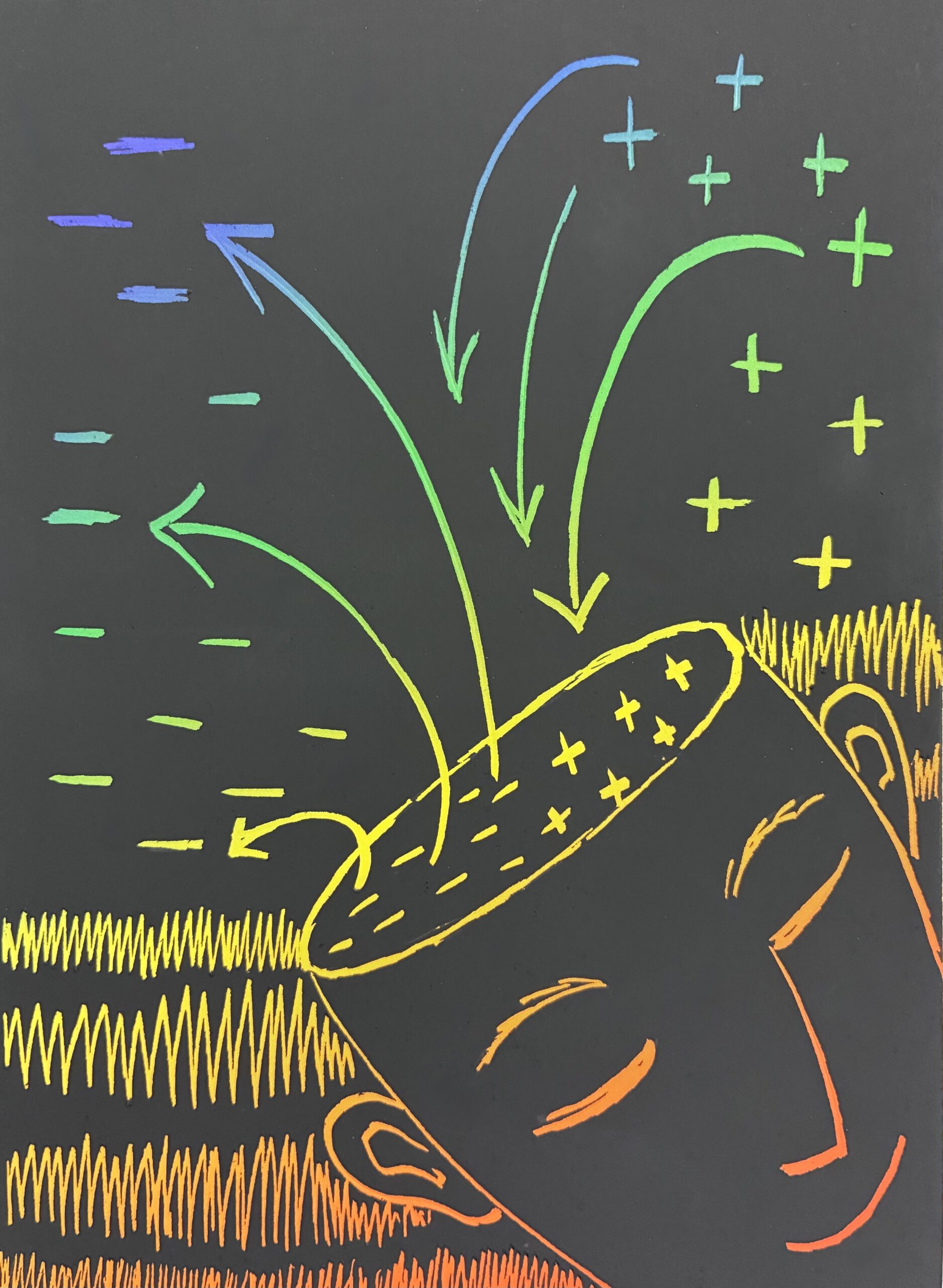
-Artwork © 2026 Jan Ketchel
The subconscious mind never sleeps. How could it, when it runs the physical body, and the energy body as well in its nightly journeys in infinity?
The conscious mind, by contrast, does nod off during sleep, and unless something wakes it into a lucid state while dreaming, it brings but vague downloads back to waking life upon awakening. Those downloads are known as dreams.
Actually, even in waking life the conscious mind can be said to be largely asleep. When driving a car, or performing a routine task, the conscious mind typically turns over the wheel to the subconscious mind that then steers the body and mind via the established programs stored within it, known as habits.
The conscious mind often takes flight into fantasy or thought until called back to task for necessary direction. When not mindfully present, the conscious mind is subject to an internal dialogue that is constantly defining and judging how it sees the world.
This judging activity actually creates the self and the world we live in through the consistency of its judgments and the personal identity it suggests to the subconscious mind.
Thus, for instance, the internal dialogue will deliver feedback every morning about the quality of one’s appearance during a quick or extended view from the mirror. It will remind us of unfavorable issues as it surveys its reflection, likely generating uncomfortable thoughts and feelings about ourselves.
Moving along, there are countless judgments about clothing, food decisions, and news and social media presentations that are categorized by such parameters as safety/threat, like/dislike, good/bad, positive/negative, approach/avoid, relax/get tense. This nonstop background judging function is active every waking moment of the day.
Once a judgment, good or bad, has been assigned by the conscious mind the subconscious mind faithfully codes it as a generalized guide that is then applied to ongoing daily encounters and reinforced by the conscious mind via passive acceptance of the judgments presented by the internal dialogue. The internal dialogue suggests what we think and feel about everything.
This dialogue establishes our true working definition of our identity. It’s how we know ourselves and are recognizable to others. The dialogue is incessantly active in the background of our minds, informing and reinforcing our sense of self. Unless the conscious mind brings its awareness to the directives of this dialogue and introduces a new perspective, this habitual mind runs nonstop, defining our lives.
Shamans covet a state they call inner silence, where the internal dialogue is abruptly halted, as an opportunity to collapse the world held in place by the internal dialogue. At such moments, one becomes privy to truths camouflaged by the internal dialogue, as it constantly generates ordinary reality.
Meditation practices that assign attention to a single focus, such as a word or the breath, accrue, over time, to moments of respite from the internal dialogue in the quiet of inner silence. However, experiences of inner silence and non-ordinary reality are not sustained indefinitely, as navigating our everyday world requires reentering a fixation upon the ordinary state of solid reality.
Quantum reality may be a truer picture of ultimate reality but the discreet physicality of Newtonian physics is crucial to functioning in everyday life. The internal dialogue quickly restores the familiar such-and-such of our consensus ordinary reality.
However, the silver lining of the internal dialogue is its magical ability to construct our world according to what we tell ourselves. It runs on autopilot but we can consciously take charge of the internal dialogue and what we tell ourselves. We can change the suggestions we deliver to the subconscious mind, from negative or habitual to positive and helpful, which are then manifested as the mental, emotional, physical and spiritual circumstances of our lives.
Yes, we can change our minds, even permanently. Mind is the spiritual substance that condenses into physical reality. A changed thought or suggestion rearranges the physical state of our being. This is our magical potential.
We can use our propensity for an internal dialogue to create a new experience of self and world. To achieve this, we must take conscious control of the internal dialogue, for good.
When we volitionally express gratitude, compassion, and loving intentions toward self and others in our internal dialogue, we become the positive being that radiates such qualities. This entails a persevering effort to bring alertness to our ever-active but half-asleep conscious mind, to be mindfully present and positive toward all things.
I am a loving, compassionate being, grateful for everyone, and in awe of everything,
Continue to be well,
Chuck