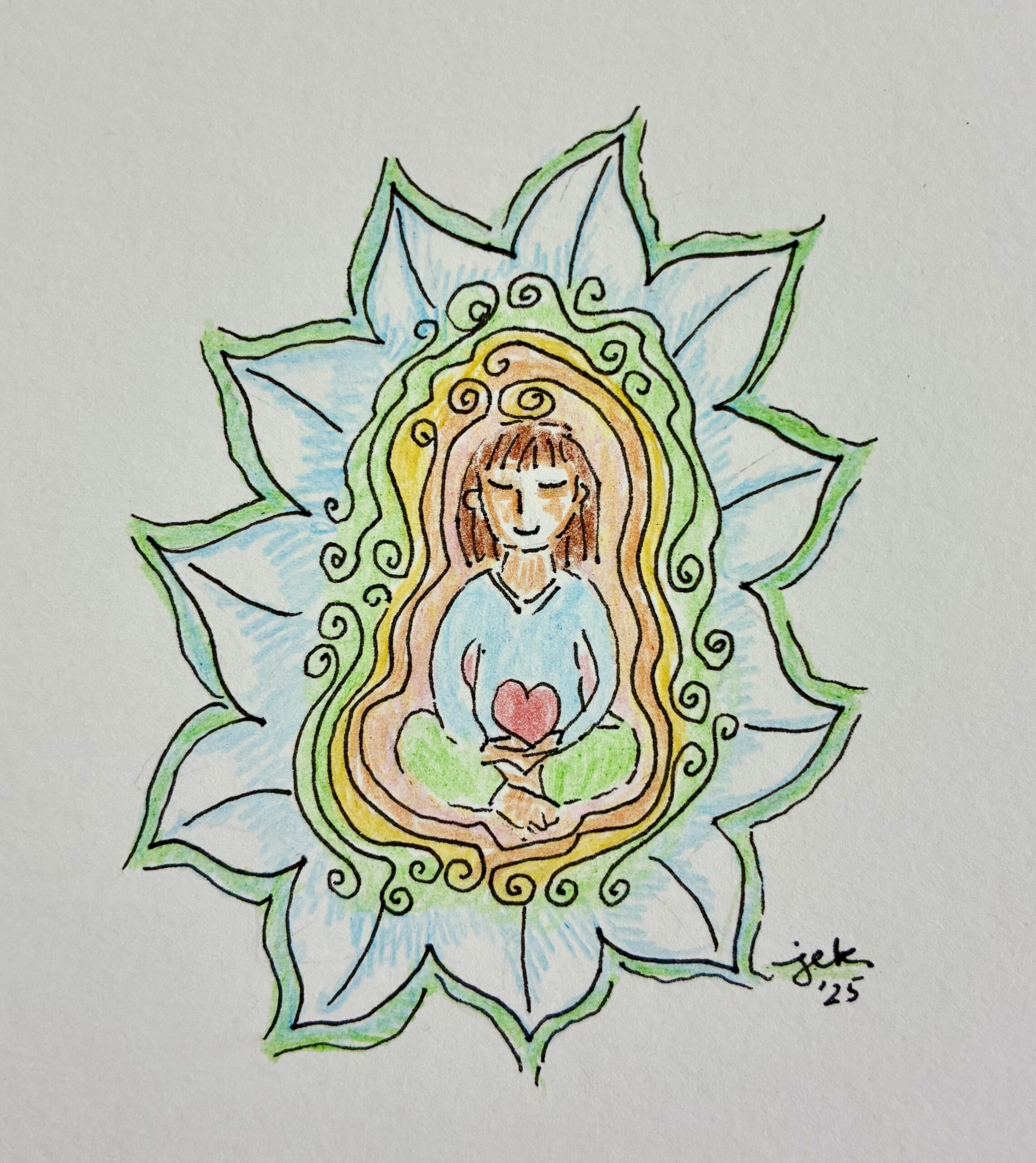
Grant yourself some time off today, a little respite from the worries and challenges of life. Grab something that helps you to relax and let go for a little while. Sometimes just a few deep breaths are enough to begin the process. Sometimes a walk in the woods is all you need. Sometimes sitting in the first rays of the morning sun will make your respite that much better. It’s okay to say no to someone. It’s okay to withdraw for some selfcare, for a self-kindness day, for a self-strengthening day, for a little bit of alone time. Let the day unfold with the intention that today is a day to pay attention to the whole self, inside and out, and to let relaxation and calmness be the words of the day.
Sit in quietude as often as possible as the day unfolds. Call to mind, and body, the relaxation exercises that suit you best. Breathe. Let yourself in on the secret that in this moment you are well, in body, mind and spirit, that you are whole and perfect in this moment. As the day progresses, remind yourself to relax, to breathe, and to just be at peace so that the day unfolds in calmness and peacefulness in your own little world. It’s one of the best things you can do for yourself. To get yourself into a restful, calm and relaxed state of being will reverberate into the world around you and you will greatly affect anyone you come into contact with.
Stay contained within the self no matter what transpires in the world around you. This is a great time of change for the entire world, both near and far; the little world of your own life and the greater far-reaching world at large. Practice keeping yourself in a calm state. Use all the tools you have learned to center and guide yourself into a state of inner and outer relaxation. You know how to do this. There are so many things you can use to help you, especially your own breath. Learn to breathe so that relaxation occurs and call upon this ability as often as necessary. Just breathe.
The truth about relaxation is that there cannot be relaxation if we are not in the truth.
If we tell a white lie, even if exquisitely justified, we will experience an excitement to the nerves that innervate our eye muscles, which will in turn throw our eyes slightly out of focus.
In fact, if we mistakenly misstate our age, with no intent to deceive, our eyes will be thrown out of focus. If we then state, or even just think our true age, our eyes will be restored to normal immediately.
The subconscious mind is responsible for this glitch. It knows the truth and cannot help but register a reaction, however subtle, to untruth. This is not from the place of morality or judgment; it’s simply the subconscious mind’s unswerving loyalty to the truth.
The subconscious mind is wired to do the right thing. This is how it keeps our physical body alive. Nonetheless, it is a true servant to the suggestions it receives from the conscious mind. It exercises its creative power to manifest anything we want, even if what we want serves not the true needs of the self. It will fully manifest a life of error, if that is what we choose to explore.
However, every thought and every action have an effect, which is often called karma. If our thoughts and actions misalign with the truth, the body will register a reaction that indeed, keeps the score.
Our thoughts and actions are constantly straining our central nervous system, often resulting in various states of dis-ease. Often this can manifest as physical symptoms that are erroneously thought to be physical problems, when in fact they are actually but feedback mechanisms from the body that reflect the disordered effects of our current state of mind.
Relaxation requires a quiet mind, where thoughts do not impose themselves upon the body.
The eye, like all senses, is a passive sense. Light waves impress themselves upon the retina, reflecting what is in the world outside of the eye. It does not see from the inside but is only impressed upon, like a small reflecting pool. Seeing is a completely receptive, inert state.
If we squint and tryto see, we completely contort the eye and interfere with its receptive ability. To see best, the eye must be left alone, completely relaxed, to receive its impressions. To trust the eye, is to completely relax one’s grip upon it.
Taste is another sense that requires complete passivity to deliver a true flavor. If the mind decides to think and talk when we eat, we hardly taste our food at all. We cannot make ourselves taste.
The sensory capacity of our taste buds passively receives impressions from the food. It requires of our mind to relax its thinking, and passively be present and attentive to these sensations, to know the fullness of the flavors of what we eat.
Even touch is a passive sense. Although a massage therapist might be quite active in giving a massage, they must really be quite passive in order to receive the true state of a client’s musculature, which allows them to truly connect and know how best to touch.
Relaxation requires trust in the body, and trust in the subconscious mind.
If we passively let go of trying to control the non-activity of our senses, they will operate most efficiently.
If we center our attention on our eating, refusing thinking and talking, we will have a pleasurable and fulfilling culinary experience. This includes not listening to podcasts when we eat!
When we touch another, if we take our mind off our thoughts, we can, in the experience of sympathy, register the truth of that other person’s state of being, and instinctively deliver the right touch. And yes, when we actively touch, we are taking action, but it is action informed by the truth passively received.
When we act in alignment with truth, we are, and deliver, calm.
A path to relaxation is to intend that the conscious mind stay in alignment with truth. That truth is best known through passive presence that follows the guidance it receives from its senses and the natural wisdom of the subconscious mind.
Beyond the senses is the wisdom that all guidance arrives when we are calmly, passively available to receive it. If the mind is actively fretting about what decision is right, it is too distracted to take in the myriads of signs from spirit, often arriving through the subconscious mind, that point to the right path, the path of true knowledge.
Ego, for all its valiant efforts to anxiously do the right thing, is at its most mature when it waits, gets calm, and truly listens and receives the truth, from which naturally flow its true marching orders.
In the late 19th century, the deeply insightful ophthalmologist, William H. Bates, discovered that the best method to improve all errors in vision was to simply relax. The demands of the then ‘modern civilization’, such as being asked to read print in its smallest font, crammed upon a page, invited the reader to strain and squint, as the eyes stressed to read outside their normal, fully relaxed receptive mode of seeing.
What became known as the Bates Method is a series of practices that restores the eyes to the autonomy of complete relaxation with the consequent effect of improved vision. Bates suggested that if we try to see anything, we are in error.
The speed and demands of our current modern civilization, as it wrestles with its pressing shadow of annihilation, is one of constant bombardment of the nervous system, with its deeply arousing thoughts and consequent emotions of anxiety, fear and fretful anticipation. Beyond the eyes, all the organs and structures of the physical body are subject to disease and dysfunction in this stressed mental atmosphere of turmoil.
Meditation is a practice which restores relaxation to the mind. When the mind is at ease thoughts are few, and largely ones of choice, versus the typical state of free association, driving a non-stop train of thought. We are hardly exempt from intrusive thought when meditating, but we do learn to calmly and definitely withdraw our attention from the unwanted thought invitations that confiscate our focus and tax our central nervous system.
When we meditate, we gather in our power of intent. Intent is the power of thought, as exercised, for instance, in the power of autosuggestion to the subconscious mind. We increase the power and effectiveness of intent through retrieving and re-channeling the energy wasted in attention to fragmented thoughts that siphon our vital energy and deliver mixed messages to the subconscious mind.
We live in a universe of thought. From without, our plugged-in generation is incessantly deluged with the thoughts of others, both human and AI generated. At the subtle level of what the shamans call inorganic life—beings or souls with mental powers but not a physical form—we are also telepathically surrounded by the thoughts of others seeking to influence our beliefs, actions and emotions.
We do have the power of intent to cast off these parasitic thoughts, but we must first purify our intent. Here, we must face our own attraction to the excitement that thoughts bring us, yes, even by religiously following the behaviors of those we find obnoxious and absurd. Like does attract like. If we want excitement, excitement will definitely find its way to us.
If we exercise our intent to detach our attention from that which excites and drains our vital energy, it slowly but definitely releases us, as the emotional food of calm that we produce is tasteless to its desire. As with the Bates Method, we are here not trying to do anything, but instead releasing ourselves from programs of thought that disrupt our true state of calm.
As we gather in our intent and power of controlled thought our nervous system slows down. Freed of activating thought impressions it releases the tensions locked in the body from the play of old thoughts, or those of others, that take up residence in the drone of our internal dialogue.
We may be naturally drawn to deepen our breath as our bodies open naturally to the oxygen and subtle prana that feed our minds and bodies. This attention to the breath takes us deeper into alpha and theta brain wave states, where, with intent, we might obtain guidance from our Higher Self, or other higher beings whose wisdom we are open and available to.
When we gather within and slow it down, all things are possible.