Category Archives: Jan’s Blog

Welcome!

Archived here are the blogs I write about inner life and outer life, inner nature and outer nature. Perhaps my writings on life, as I see it and experience it, may offer you some small insight or different perspective as you take your own journey.

With gratitude for all that life teaches me, I share my experiences.

Jan Ketchel

A Day in a Life: Face the Chaos & Question Everything

We must all make personal decisions that are right for us, but we must also challenge our selves to go beyond our limitations. We must ask ourselves: What is the possibility that I may be getting this wrong, that I am not seeing something? What am I missing? We must all take personal responsibility for our lives, for how we interpret our experiences, and how we ultimately decide to view and live in the world.

During my three-year long intensive recapitulation, I learned how to question not only the reality that I was encountering from my past, but also how I was going to interpret it this time around. Could I really trust that what came to greet me out of old forgotten memories had really happened? How could I embrace the truth of what I was learning about my childhood? How could I take it all in and move on to a new interpretation of what it meant when what I was reliving was often so devastatingly overwhelming that some days I could not even get out of bed?

I learned how to question everything. This was the only way I was going to get through the recapitulation of traumatic events from my childhood that had held me so tightly in their embrace for decades, though I had little or no inkling of this fact. I knew little about Post Traumatic Stress Disorder and the tentacles of trauma that infiltrate every aspect of a person’s life until finally faced. For the most part, I felt that I was not really living life as I sensed it could be lived, but I did not know why until I elected to take the recapitulation journey. When I began to allow old memories to surface I had to face old judgments, prejudices of self and others, truths and lies that were incredibly uncomfortable to confront, disassemble and release myself from.

The entire time I worked through this recapitulation process I also disassembled the world as I knew it, the outer world as well as the inner world—one could not hold up without the other. As I deconstructed the old self, I found that I could not live in the same world that the old self had constructed. Recapitulation meant a total disintegration of the self I had been. So, as a result, who I thought I was and how I viewed the world all changed as I plodded along, chipping away, day by day, at what I thought was reality.

Some days I would wake up in such pain that I immediately wanted to seek medical advice, but at the same time I knew there was nothing in the conventional medical world that would help the somatic experiences that my body was telling me I had to go through. There were times when I did indeed need to go to the doctor, like the time I had Lyme disease and could not walk or think properly. There were other times when what was buried inside produced real physical symptoms that needed attention, though I knew they originated from something deep inside me looking for a way out, like the time I had skin cancer. I knew it was not related to sun exposure, but to the unknown stuff that was putrefying inside me, needing release. I had to learn to distinguish between these issues by questioning the reality of my situation and determine how to address them, taking full responsibility for my choices along the way.

As I faced some very painful memories, I had to learn how to let myself be taken into other worlds, knowing that I had the power within to face the truth that those worlds were indeed as much reality as the everyday world that was looking more and more unreal to me. As I recapitulated, I learned, by taking one incremental step at a time, how to be an observer as well as a participant in those alternate realities. In strengthening my inner conviction to complete the task my body was laying out for me, calling me to, I found that I had within me more than enough personal power to face the challenges presented and change the way I experienced everything.

I learned to question everything too; from the physical symptoms I was experiencing to the way I thought. I let myself learn, through the process of recapitulation, to perceive reality differently—reality being all the conventions I had been taught and adhered to, all the beliefs and ideas that kept the world in order. I allowed myself to blow apart everything that held me together. In the end it was my salvation. It not only changed the way I viewed the world, but it changed the way I viewed my place in it.

What am I really here for? What is it that I must do in this lifetime? I knew I was not here for a selfish reason, that to be eternally depressed and self-absorbed was not going to cut it in the long run. I knew that I was no longer going to be able to hide, to isolate myself in a private world of make-believe. I faced the deepest kind of isolation and make-believe during my recapitulation process and found that they no longer granted me anything of substance, though at one time they had been the backbone of my entire existence.

In constantly questioning the true meaning of my life throughout the recapitulation process, I learned that the main thing I was being asked to do was to break down, literally. I had to deconstruct my entire being, inside and outside, into tiny pieces that I then had to sift through before finding the proper way to reconstruct those pieces into new pictures. As I broke down the past, I also learned how to break down the present and, in so doing, be open to a new kind of future.

I know that all of this may sound very esoteric and impossible to do in the context of a very busy life, with all that we must encounter each day to simply survive, but it is not that difficult if one is committed to change. From personal experience, I can say that the recapitulation process is one of total reevaluation of self and world, leading to the ability to take full responsibility for both. It means taking on the challenge to committing to change with a conviction that defies all other methods.

Perhaps the most helpful part of the entire recapitulation experience, a simple statement that not only anchored me as I entered the darkest and most complicated issues of self and world, was this one: Question reality. Chuck said this to me on more than one occasion.

One day it came up in our conversation as the most meaningful of statements and the next day I was driving behind a car that had an enormous bumper sticker plastered across its fender saying the same thing in large letters: QUESTION REALITY. I could not ignore that it was exactly the right message. In continually questioning reality, I was able to not only face my darkest moments but re-envision them in the context of a new world, a world that I was totally in alignment with, having allowed it to form out of my deepest inner process.

I wish for all people to have a new world vision, but it can only happen by facing the world that we have constructed. This is what we are facing now as a nation and as a global world, but most importantly, personally. We are facing the reality we have created, trusted, and believed in. But now we must re-envision it. It is time to see it for what it is: a reality of exploitation, distrust, greed, selfishness, with little regard for human, animal and natural life. Are we really so heartless?

How can we re-envision a just and right world for all? In questioning reality as it now stands, breaking down the rules and dogmas we have lived by, facing the truth that we are all responsible for everything that has happened and is happening by our adherence to old ideas, tactics, and habits, we can begin to change.

We must all change. This, I believe, is the only way for us to evolve. But even change must be radically different from the means of change as enacted in the past. It is not enough to reinsert new rules that uphold an old order. It is time to face the chaos. Only in facing the chaos within will we be able to face the chaos without. If we don’t do that we will simply reassemble what we have already discovered does not work. We must indeed question everything about ourselves; about the worlds we live in, and ask ourselves to face the truth of the existence we have constructed.

Why am I really here? Personally, I continue to face that question each day as I read, write, meditate, and break through the conventions that arise. The old world will never give up on me; it will continue to pose its side of the story. But I must face it and ask: Are you the reality I wish to live in? The answer that always comes up is a resounding: No.

Still questioning everything,
Jan
A Day in a Life: Dancing Crows

Last week Chuck and I had many discussions around the subjects of good and evil, death as an advisor, impermanence, the shadow, accepting that we all have inner demons, negative energy, the capacity to commit murder, and that we must all face these things at some time in our lives or risk having to reincarnate. The subjects kept coming up again and again in various circumstances and encounters. As we sat at the breakfast table early one morning over the weekend a synchronistically powerful event occurred right before our eyes that we just could not escape. It was supremely meaningful, underscoring the very conversation we were having at the time, which centered around the capacity that we have as human beings to hide from our true nature, to want to pretend that we are only good, and how hard it is to confront the truths of our inner darkness. Life would be so much easier if everyone were happy, good, loving, kind and compassionate. I totally agree and could wish for nothing more. But as any Buddhist will tell you, it can take a lifetime of intense inner work to reach even a moment of enlightenment.

The following is a quote from The Tibetan Book of Living and Dying by Sogyal Rinpoche, which I am particularly fond of and drawn to almost daily.

“One of the chief reasons we have so much anguish and difficulty facing death is that we ignore the truth of impermanence. We so desperately want everything to continue as it is that we have to believe that things will always stay the same. But this is only make-believe. And as we so often discover, belief has little or nothing to do with reality. This make-believe, with its misinformation, ideas, and assumptions, is the rickety foundation on which we construct our lives. No matter how much the truth keeps interrupting, we prefer to go on trying, with hopeless bravado, to keep up our pretense.” -from page 25.

The author goes on to say the following:

“Reflect on this: The realization of impermanence is paradoxically the only thing we can hold onto, perhaps our only lasting possession. It is like the sky, or the earth. No matter how much everything around us may change or collapse, they endure. Say we go through a shattering emotional crisis . . . our whole life seems to be disintegrating . . . our husband or wife leaves us without warning. The earth is still there; the sky is still there. Of course, even the earth trembles now and again, just to remind us we cannot take anything for granted . . .” -from page 25 and 26.

So, what occurred before our very eyes last weekend that so profoundly affected us, as we sat at the breakfast table and chatted over our omelets and toast?

I was sitting and facing the backyard when I noticed a pair of crows doing a funny dance in the sky. They were twirling, diving and whipping about as if in the throes of a mating dance. This was my first exclamation as I pointed them out to Chuck: “Look at those dancing crows!” But there was something odd about them at the same time; they did not look really happy and I had never seen crows doing such antics. Normally they are very businesslike. They fly with purpose, heading directly to their intended destination with little fanfare or distraction. These crows were acting very strangely indeed.

We both got up from the table to watch more closely when I saw that they were not doing a mating dance to new life at all, but were in fact doing something more like a dance with death, for we saw that a huge hawk was sitting in the tree close to their nest and they were dive-bombing him, trying to scare him off. They were dealing with the true nature of reality: death comes to call; no one can escape it. They could not ignore this truth, but they could put up a valiant fight to save their young. And indeed they did. We watched as the crows repeatedly attacked the hawk, and eventually, scared it off the branch. Their fight continuing in the sky, they dove at it continually, cutting it with their wings, sending it spinning at one point and, eventually, the hawk flew off. I said to Chuck: “He’ll be back. He’s not going to give up. Just wait.”

The hawk came back

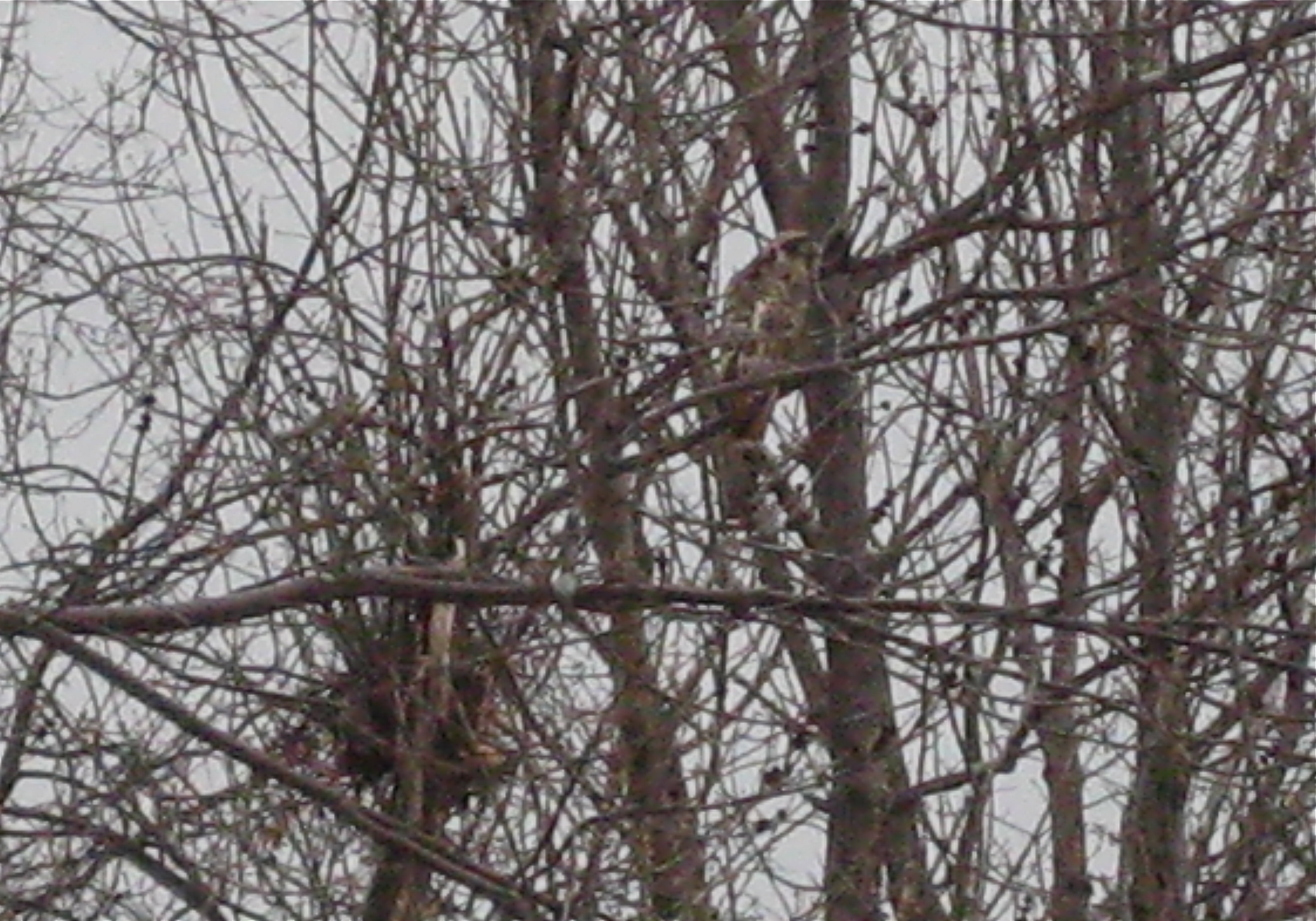
Perhaps an hour later I happened to look outside and saw that the hawk was indeed back, his head stuck inside the nest, pecking away. The crows were nowhere in sight, but I could hear their gentle keening coming from a distance, acquiescing to the inevitable. Death had come. They were accepting the impermanence of life, that change had come and they could not do anything to thwart it, their mournful cries marking this truth.

Chuck and I watched the hawk tearing at something under its claw, though even with binoculars it was difficult to see what it was; an egg or a baby crow we could not tell, but the truth was plain to see. Eventually the hawk flew off the branch and, as it did, the crows flew up out of hiding and, with one last cry of pain, attacked it again before it flew off for good. I expected the crows to return to the tree where their nest lay disturbed, but was surprised to see that they did not. “Wow,” I thought, “they really do accept the loss, they aren’t even looking back, just moving on.”

I don’t know what transpired after that, if they did in fact go back to see if anything had survived, but I think they already knew that nothing remained, that the hawk was just doing what he should do, what they in turn do to smaller birds; that it was just nature. But the sky was still there, as Sogyal Rinpoche writes, and they took off into it. The earth was still there too.

What is our life but a dance with death?

“What is our life but this dance of transient forms? Isn’t everything always changing: the leaves on the trees in the park, the light in your room as you read this, the seasons, the weather, the time of day, the people passing you in the street? And what about us? Doesn’t everything we have done in the past seem like a dream now?… We are impermanent, the influences are impermanent, and there is nothing solid or lasting anywhere that we can point to.” –The Tibetan Book of Living and Dying pages 26 and 27.

The only thing we can really count on is now, this moment, this breath we take, this truth that at this moment in our life we are alive. And then the next moment is upon us, even as we let the last one go. Each moment is as impermanent as the last.

Personally, I am awestruck by such acts of nature. They are always thrilling moments. I feel lucky to live where I do, that I can have such moments of brilliance in my life, that I am offered such grittiness to reflect on. I cannot say that I would be able to fly off as easily as those crows did, though eventually I get there. I know myself well enough now; that after many years of inner work I am fully capable of walking on into life without regret or sorrow. I know how to face new life, letting go of the past, though I have learned to appreciate that death, in its many forms, always accompanies me.

I don’t mean to be morbid, especially with so many experiences of life abounding now, each new spring day bringing nesting birds, emerging plants and flowers, the earth reawakening. But I cannot help but point out the truth that we are all impermanent, that we must all one day dance with death. We already do it all the time, in so many small ways.

We must learn to face our own deaths each day, preparing for it in our thoughts and actions, learning from the crows how to let go. We must also learn from the hawk that we too are capable of taking what we need to live; we too kill to survive. We must keep learning from the people in our lives how to face the transient nature of life, learning from them what the most important questions to keep asking are. We must all face the truths of our make-believe worlds and face the grittiest of the truths of reality. I am thankful for everyone who is a part of my life, even if only peripherally, for showing me that everything is meaningful and how important it is to keep working on the personal inner process.

As the seers of ancient Mexico are so fond of saying: I am a being who is going to die. The hawk and the dancing crows teach us this. Chuck and I learned this again last weekend as we watched this lesson play out in the sky. But, in the meantime, we intend to fully live, for we have so much to still learn.

Living fully, sending you all love and good wishes,
Jan

If you wish to correspond, please feel free to post a comment below. And don’t forget to check out our facebook page at: Riverwalker Press on facebook where we post comments, photos, and quotes.

A Day in a Life: Seeds Scattered Upon the Earth

I sit on my meditation pillow and do the sweeping breath; exhaling, emptying of breath while turning my head to the right, breathing in while moving my head to the left, and then holding my breath while I sweep my head back to the right again. I do this over and over again, sweeping back and forth in an effort to recapture the dream I had last night. I have most of it, but there are a few details that I want clarified. The shamanic sweeping breath, the recapitulation breath, works like EMDR to capture experiences, dream and otherwise.

In my dream I am planting a garden. Chuck is with me. We have prepared everything according to what we feel is good for the earth, for the soil, imbuing everything with our intent to do it right so that everything we plant will feel welcomed and loved and provide us with sustenance and nurturance in return. Now it is time to put the seeds into the ground. I am standing with my cupped hands full of seeds. I am looking at them intently, knowing that I have done everything to prepare for this moment, but still I am aware that something is missing.

Ethereal Light

Chuck is standing next to me, also looking at the seeds in my hands, both of us trying to figure out what it is we have forgotten. Suddenly there is a loud crack and the pile of seeds is emblazoned with energy. They glow with a vibrant ethereal light and then I know that this is what is missing, the energy of Mother Nature beyond what we personally could intend. At the same time I am startled awake, because the loud crack was, in reality, a powerful jolt of lightning and thunder that rumbles on and on, Mother Nature, the earth reminding us of her power.

“It sounds like an earthquake shaking the earth apart,” Chuck said, as we lay awake listening to its insistent rumblings, the significance of this statement highlighting the truth of what has been happening lately in Japan and other parts of the world. As we fell back to sleep I thought about writing the dream down so I didn’t lose it, but I chose instead to replay it over and over again in my mind so I could more readily remember it in the morning. Alas there was something missing when I woke up too, just as I knew there was something missing as I stared at the seeds in my hands during the dream experience itself.

Doing the sweeping breath helps clarify the intent of the dream, which I am aware, is teaching me something important. What I remember now is that at the moment of the crack of thunder I was aware that I was as the tiny seeds in my hands, that no matter what I personally did it was the energy of Mother Nature, in all of us, that would determine the outcome of my garden. It is important to prepare for life, for planting, making preparations according to what is in alignment with what is right, but it is hubris on our part to think that we can control anything. It is important to be an active participant in life, but the truth is that the energy of life, of nature, is unstoppable.

This is what I also understood as I lay in the dark listening to the thunder rolling and cracking open the silence of the night. In all that I have been writing about lately—pointing out the decisions that we have all taken and that we are all responsible for, whether we agree with them or not—in the end, the one who will determine our fate will be the Earth itself. Mother Nature holds the real power.

We are but seeds scattered upon the soil, we fall were we fall. We must each one of us find our way with where we have landed in this life. Some of us live in the richest country in the world, in a material sense. Some live in a country with a belief in the richness of Mother Nature, Pachamama, as I mentioned in a note yesterday regarding Brazil’s law of equality, granting nature and all living things equal status with humanity. How is it possible that such diverse and drastically different attitudes exist? On the one hand our own country of America continues making decisions to ravage and destroy the earth in an effort to uphold our standard of living, while another country seeks to return to ancient alignment with the earth. The truth is that Brazil too has ravaged the earth, but now seeks to return to ancient alignment and identity with nature. Something powerful is being expressed in turning to this other truth that lies at the heart of our human presence upon this earth.

As in my dream, something is asking us to pause now and question what we have done. We are at a crucial moment in our time, but synchronistically in the time of all living things. We must all ask what is missing. What is it that we have not done to prepare, what is not right here? What have we forgotten?

Mother Nature has the answers. As we see happening in Japan, in Arizona where fracking for natural gas has unleashed earthquakes deep inside the earth, in the tragic truths of gas drilling in the Gulf of Mexico, mother nature is responding, even as she did in the night as I dreamed. I take the synchronicity of that loud crack of thunder at the moment I was dreaming very seriously. I also see its synchronicity in all that I have been reading and writing about recently, in the wake of national and international events and discussions regarding how we all treat the earth.

Even as I was wondering in my dream what was missing from my own little effort to do something earth-sustaining, taking personal responsibility for growing some of my own food, nature herself spoke loudly and clearly, reminding me of her powerful presence in my life and in all life as well. She is life and she has something to say. We all need to listen.

I don’t mean to be preachy nor do I wish to impose my personal beliefs. I think we must all come to what feels right for us personally, but at the same time I do strongly feel that it would be amiss to not point out the synchronicities all around us. I truly believe that Pachamama must be treated with respect and awe—not simply granted equality with humankind, though this is a good start—because she is far more powerful than we are. This is the truth I learned in my dream.

I am just one little seed, sending you all love and good wishes.
Jan

If you wish to correspond, please feel free to post a comment below. And don’t forget to check out our facebook page at: Riverwalker Press on facebook where we post comments, photos, and quotes.

A Day in a Life: Illusion or Not?

I ponder the world as illusion. While channeling Jeanne’s message on Monday, I reached a personal moment of enlightenment when I grasped the idea that the inner world and the outer world are the same, that both are real and both are illusion. Carl Jung once noted that the inner world was as real or perhaps more real than the outer world. This has always been my experience, more of an inner world person than an outer world person. What I experienced in that moment of enlightenment on Monday was, from a shamanic point of view, a shift in the assemblage point, a shift in perception. This is when the world, as we know it, suddenly falls away and everything is seen and perceived differently. When this happens we are in another reality, “seeing” the world as it truly is, in shamanic terms, seeing the world as energy. So with that in mind, holding onto the idea that both worlds are real and illusory at the same time, I went into my week.

On Tuesday, I sat down to meditate in my favorite spot, looking out over the trees in the back yard. It was early morning; the sun was beginning to rise, battling the clouds for prominence. I wondered what the day would be like, rain or sun? I meditate with my eyes open. I softened my gaze as I did my breathing exercises, holding onto the out-breath ever so slightly in an attempt to linger a moment in emptiness and detach from thinking. Eventually, by focusing on slowly breathing in and out, I reached an in-between stage, where the outside world dissolved into a blurred picture and the inner world went quiet. This is a moment of shift in the assemblage point.

Sometimes I can stay suspended in this in-between space for a few seconds, sometimes longer. It’s as if my awareness is a thin sheet of glass, suspended between these two normal states of reality. I say thin, because invariably something will interfere to bring me back and then both the inner world of thought and the outer world of everyday reality come snapping back into sharp focus again. On Tuesday it was a flock of crows flying into the backyard that broke through the thin veneer of glass.

“Oh, here come the shamans, come to distract,” I thought. “Don’t attach.” And the glass immediately shattered as I watched the crows land in the trees right at eye level.

“Don’t attach,” I said again, softening my gaze. As I did so, I noticed that the crows literally dissolved as the glass pulled up between the two worlds again, which obviously was enough to pull me right back to thinking, to trying to grasp what I was experiencing. Of course, I wanted to check out if the crows were indeed still in the trees. So I looked directly at the treetops and yes, there were the crows sitting right where they had been.

“Okay,” I thought. “The crows are like these thoughts, flying into my mind and I must learn to let them go. I must learn to detach.” Again, I softened my gaze; focused on breathing, telling myself to let them fly past, just like the thoughts that were interfering.

“Even if those thoughts are attempting to grasp at this awakening experience I am having, it does not matter, let them go,” I said as I pushed everything away: thoughts, crows, trees, the inner and outer world.

“Just let it all go,” I whispered and, as the scenario played out, the thoughts flew away, the crows dissolved, and the thin sheet of shift, the glass, reappeared. I hung again in a moment of shift of the assemblage point, in inner silence, as the shamans call it, in nothingness, ever so briefly.

So, what did I learn during this experience? First of all, I experienced a volitional shift of the assemblage point, changing my perception of reality using a tried and true method: by meditation. Secondly, I saw the crows of thought and illusion dissolve into energy. If the crows are thoughts and thoughts belong to my inner world, I was able to underscore the moment of enlightenment I’d reached on Monday that the inner world and the outer world are both real and both illusion.

As I pondered this idea further, I thought about how thoughts are present only in the mind. In fact, they do not exist except in the mind, but they have the chance to become real when given form. In creative endeavors, as we paint, sculpt, dance, put them down in words and musical notes, as we write what we think, imagine, and discover, they manifest in this world of reality, no longer illusion but real. But until that manifestation they are illusion. These thoughts I now transcribe, though they existed in my mind, remained illusion until expressed in this form. They flew around in my head like those crows outside the window, seemingly real but not necessarily so, until this moment of landing, assembling into a long string of words that, hopefully, make sense.

I understand, in one sense, that my inner world, as real and important as it is to me, does not exist. And yet, I admit that it is extremely necessary, offering me the means to evolve, so I accept that my inner reality does exist. Even those very real crows existed one moment, but in the next dissolved, as I shifted my assemblage point so that the world of normal perception, reality, ceased to exist. At the same time, however, both the inner world and the outer world do exist; they are notches on the assemblage point. They are equally real, but equally illusion. But the thing to note is that our true awareness lies somewhere between or beyond those worlds, in the silence of that veneer of glass that is so hard to stay in. Does this make sense?

What I am getting at is that we all have these experiences. Our thoughts are simply thoughts, non-existent, present as energy inside us. If we can view them as such, we may be able to understand the idea of everything as illusion, but also as energy. When we hone that energy into something else, our thoughts become something different. They become tangible, expressed in forms that others can grasp, our personal experiences of illusion, of inner energy manifested.

Can we see the outside world in similar terms? The shamans say that our conjuring minds are responsible for the world of reality. We are taught from birth to see the world in a fixed position, and yet we all have had experiences of shifts in reality at some time or other in our lives, as Jeanne asked us to note in her message the other day. If thoughts are illusion, conjured by our mind, made manifest in the outer world, is not then the world of reality, conjured by this same universal mind, illusion as well? If everything we experience as reality at one time existed as thought, it stands that it can also dissolve back into its original energy form of thought, and thus, illusion.

As I sat and played with this idea the other day, dissolving the crows out of the trees one minute and placing them back in the trees the next I got it again, just how illusory the world is. My thoughts are nothing, the crows are nothing, I am nothing, but we are all energy. If we can hang just a little bit longer in that thin slip of world between the two illusions we may experience this sense of self as energy.

And why would we do this? As we shift our assemblage point, as we see differently, as our worlds dissolve, as we hold onto our awareness, we begin to train ourselves for the moment of death. This is what the Buddhists do, what the shamans do; they train their awareness for the moment of death. They learn how to hold onto awareness, how to stay connected to awareness of the self as energy so that, at the moment of death, they do not get caught in the illusions. They seek to hone the skills of awareness, so that they do not get caught in grasping, needing, desiring, in sadness or yearning for this world, which they have learned is but illusion.

According to these ancient disciplines, of Buddhism and shamanism, this is what we are here to learn. We are here to free ourselves from the endless cycles of being caught in the illusion that this is all there is. We are offered, with each new life, the opportunity to experience the moments of awakening to our true nature as energetic beings. This is what Jeanne was describing and asking us to note in her message.

Take note of the moments when the illusions of reality disappear, those aha moments when we experience life differently. These are the moments to keep striving for, to string together, until we fully grasp their significance and can volitionally return to them again and again. We must seek the space of thin veneer between worlds and thicken it so that we can stay in it longer. We must seek our true awareness and set it free in that in-between place; because that is what we will need to recall and hold onto at the moment of death.

The cool thing is that we are offered plenty of those moments of enlightenment now, in our present lives, in our present worlds. Try it. It’s fun!

Thanks for reading and passing these blogs on to others! Sending you all love and good wishes.

In awareness,
Jan

If you wish to correspond, please feel free to post a comment below. And don’t forget to check out our facebook page at: Riverwalker Press on facebook where we post daily comments and quotes.

A Day in a Life: On the Road to Mindfulness

The world has grown larger in the past couple of centuries as we have gone beyond our villages and towns, beyond our states and countries, as we have sailed and flown to foreign parts and discovered other villages, towns, and countries. Hopefully, we have learned that the people in those other countries are just like us; flesh and blood, with feelings, emotions, likes and dislikes; that they also love certain things about life; that they love their children, husbands and wives; that they too are fallible and make mistakes just as we do. Hopefully, we have gained a broader view of humanity as a whole and now understand the greater interconnectedness of all things and that we are all responsible for what happens on our planet no matter where we live. Hopefully, we have learned that we are all the same in so many ways, because now may be the time for us to return to our villages and towns and countries, taking with us all that we have learned. Now may be the time for us to utilize what we have learned, for all humanity.

With the crisis in Japan the world has changed. We must accept this fact. We must figure out how we want to live now that we can no longer rely on trade with Japan to support our abundant lifestyles. Our cars must come from within our own borders, our food must be local, our responsibility to the entire world rests on us all making changes that are good for the Earth. We must not only change our personal lives, but we must pressure our governments to change as well, to be a part of the greater world without a doubt, but to make decisions that take into consideration the larger global picture that we have a greater understanding of now that we have all become world explorers. But it is time for the explorers to take what has been learned and, with that new knowledge firmly grasped, return home and change.

So how can we personally change? How can we as individuals make progress toward changing the way things are done? We can start with mindfulness. In the Buddhist sense, mindfulness is staying present in the moment, in as many moments as possible throughout the day. It is being mindful of how we walk, how we eat, how we talk. It is being mindful of how we drive, how we spend our time, how we think. It is being mindful of how we love, how we give, how we receive. It is being mindful of what we choose to look at, read, and allow into our bodies. It is being mindful of our thoughts, judgments, criticisms of our self and others. It is being mindful of our intents, our prayers, our desires. In essence, being mindful is being aware, and being aware of ourselves in the world is how we can be mindful of how we can change.

In practical terms, we must first accept that we are all living in Japan now. Our world has changed. That is the first thing we must take into consideration as we turn and study our personal responsibilities to this changed world. How can I mindfully be present and aware?

“Most of the time, we are lost in the past or carried away by the future. When we are mindful, deeply in touch with the present moment, our understanding of what is going on deepens, and we begin to be filled with acceptance, joy, peace, and love.” So writes Thich Nhat Hanh in The Long Road Turns to Joy, A Guide to Walking Meditation.

I propose meditation in everyday life, in constantly reminding the self to be present, as the means of gaining greater awareness of ourselves in the world and greater awareness of what we must do to change and flow with the energy of nature, now guiding us in this process of change. This does not have to be anything more than reminding the self to focus on each task that we do, to do it mindfully. Personally, I try to be mindful from the moment I wake up. I am not always successful, since it is impossible to be mindful every moment of every day, but the more often I pull my thoughts back to what I am doing the more I am able to be present. Each one of those tiny moments of presence, of awareness of the moment, adds up. Being mindful throughout the day is really very simple.

When I get out of bed and put my feet onto the floor, I say to myself: I am putting my feet onto the floor. I feel the floor under my feet. I am walking, walking, walking. I am waking up with each step. I am noticing the morning darkness or the morning light. I am walking.

When I make my morning coffee, I say to myself: I am making the coffee. I am running the water, measuring the coffee, thanking the earth for the water, the coffee plantations for the delicious coffee beans. I am staying mindfully focused on what I am doing, turning this process into a mantra as I awaken to a new day mindfully. When I drink my freshly brewed coffee, I say to myself: I am drinking this coffee. I am drinking and feeling each sip I take. I am mindfully drinking my coffee.

As the day goes on, I continue to remind myself to pay attention to what I am doing. When I eat, I say to myself: I am eating now. I am eating this delicious food that someone else has grown and tended and I thank them for it. If I keep thanking and focusing on what I am doing other thoughts easily leave, but they come back quickly, so I must again remind myself of what I am doing. This is practicing mindfulness.

In accepting that we are all personally responsible, as citizens of the world, we can turn to the small things in life as the place to begin making the most changes, having the most impact. As we mindfully go about our day we may discover where we are sloppy with our time and thoughts. We may discover that, as we pay attention to each task, we slow down considerably and in so doing gain not only peaceful moments of calm, but discover that we don’t really need to hurry at all, because we see that in slowing down mindfully we have plenty of time for the things that really matter. And that is the crux of what our world is asking of us now. What really matters?

Mindfulness is awareness of the present moment

“The First Noble Truth,” writes Thich Nhat Hahn, “taught by the Buddha is the presence of suffering. Awareness of suffering generates compassion, and compassion generates the will to practice the Way.” If we are to practice the Way, live mindfully in balance with nature, inner and outer nature, we must be aware of suffering. Right now there is suffering in Japan, in the Middle East, and in our own countries there is suffering every day.

We can mindfully remind ourselves of this by saying: I am aware of the suffering in Japan. I am aware of the suffering as the wars in the Middle East are waged. I am aware of the suffering in my own backyard. I feel this suffering. I accept the truth of suffering. I know what it means to suffer too. I now turn my heart outward and send compassion on the wings of intent. I am mindful of my power to change and to change the world by my intent.

This is mindful living. Try it.

Thanks for reading and passing these blogs on to others! Sending you all love and good wishes.

In mindfulness,
Jan

If you wish to correspond, please feel free to post a comment below. And don’t forget to check out our facebook page at: Riverwalker Press on facebook where we post daily comments and quotes.