
Tag Archives: ego

Chuck’s Place: Holding Space for Trickster

Shining the light upon Trickster’s stupendous web…
– Photo by Jan Ketchel

Holding space means being with someone without judgment. Holding space means being fully present without seeking anything in return. Holding space means bearing the tension of opposition. Holding space means unconditional acceptance of all that is. 

Trickster is the child in all of us who simply refuses to conform to civilized expectations. That child will undermine our ego’s best intentions, as we find ourselves breaking our deeply fought for resolutions at trickster’s instigation. In a heartbeat, trickster will concoct a reason to open the refrigerator or peek at Facebook. Later, defeated and guilty, ego contritely starts anew on its road to self-improvement.

Before we completely demonize trickster, let us ponder a koan from Jesus. In Matthew 18: 2-4, Jesus is quoted as stating, “Truly I tell you, unless you change and become like little children, you will never enter the kingdom of heaven.”  Clearly, the suggestion, on some level, is that, holding space for trickster is fundamental to spiritual evolution.

Trickster is a character that appears in the mythology of all cultures. Phil Jackson, of immortal basketball coaching acclaim, bestowed upon one of his star Chicago Bulls, Dennis Rodman, so called “best friend” of Kim Jong-un, the role of a Heyoka, a Lakota Indian trickster spirit, who both crossdresses and does things backwards to challenge the prevailing order of the tribe.

Phil Jackson recognized the necessity of holding space for this most unruly of characters, who would at times cost his team games and at other times help teammates to get over their self-importance and just have fun playing basketball. Like noted physicist David Bohm, Jackson knew the value of bearing the tension of full wholeness, over merely expecting goodness, in elevating a team to a higher level of play.

Jackson stressed the practice of patience in allowing another person to be who they were going to be, and while not protecting them from the natural consequences of their actions, not excluding them from the team either. In fact, he stressed the critical necessity of all-inclusiveness, including even the most vile trickster, in the building of a whole team.

David Bohm insisted that the way to advance civilization’s survival was to bring together all disparate characters at a roundtable of dialogue. All would commit to suspend judgment and merely express themselves and get to know their neighbors. The objective is not to advance one’s view over another’s, but simply to be part of this living wholeness.

Bohm predicted that this full presence alone, devoid of any attempt at convincing, would in itself give rise to the necessary resolution of difference. Perhaps his vision is similar to a Quaker service where, in the presence of the wholeness of the group, guidance spontaneously emerges in a channeled message. This was his social equation for human resolution, as he realized that at the most quantum subatomic level, only through the removal of subjective prejudice could science arrive at the fullest truth of energetic reality.

The trickster in all of us is our inner hero in the rough. Trickster is the ultimate Freudian slip, where the truth is most uncomfortably revealed. Perhaps that truth has laid bare one’s pretentious host at a party, or exposed one’s own most sensitive sore spots.

Trickster is daring, indignant, irreverent, ruthless, charming, hilarious, playful, spontaneous, sensitive, insensitive, attention-seeking, and highly self-centered. Trickster disdains reason and is far more driven by impulsive opportunity to shock and disrupt. Don’t expect trickster to be good at the party. Trickster is already eyeing the desert when you first walk through the door.

Don’t shut out trickster’s truth. Be patient and suspend judgment upon  the full truth of the self. See what might emerge as you bear this tension. If trickster appears outside the self, in the person of another, recognize its value as petty tyrant. In Carlos Castaneda’s shamanic lineage, trickster as petty tyrant is the person who most deeply offends us.

Typically, these are the characters one would prefer most to not have in one’s life. But, from a spiritual advancement opportunity, petty tyrants require one to completely relinquish the ego’s self-importance by not engaging in a defeatist argument in a futile attempt to defend oneself. Trickster also lays bare any proclivity to self pity, which in itself depresses the ego into immobilization.

Alternatively, if one can contain one’s anger and hurt within the cauldron of self, and travel down the rabbit hole of holding space beyond one’s hurt ego, one may be led on a journey of enlightenment to hidden memories and attitudes, which reveal previously veiled truths about the self.

Trickster may never mature, but trickster will challenge one to get beyond the limitation of self-importance that burdens all egos.  It may very well be that trickster’s irreverence persists only until ego truly grows up to the truth of right action, and assumes appropriate leadership. From that accomplishment trickster moves on, in its own mercurial way, to force attention upon another of ego’s many blindspots.

Most importantly, trickster offers us the opportunity to recover our lost innocence, the awe that leads to spiritual advancement.

Holding space for trickster,

Chuck
Chuck’s Place: Unbending Detachment

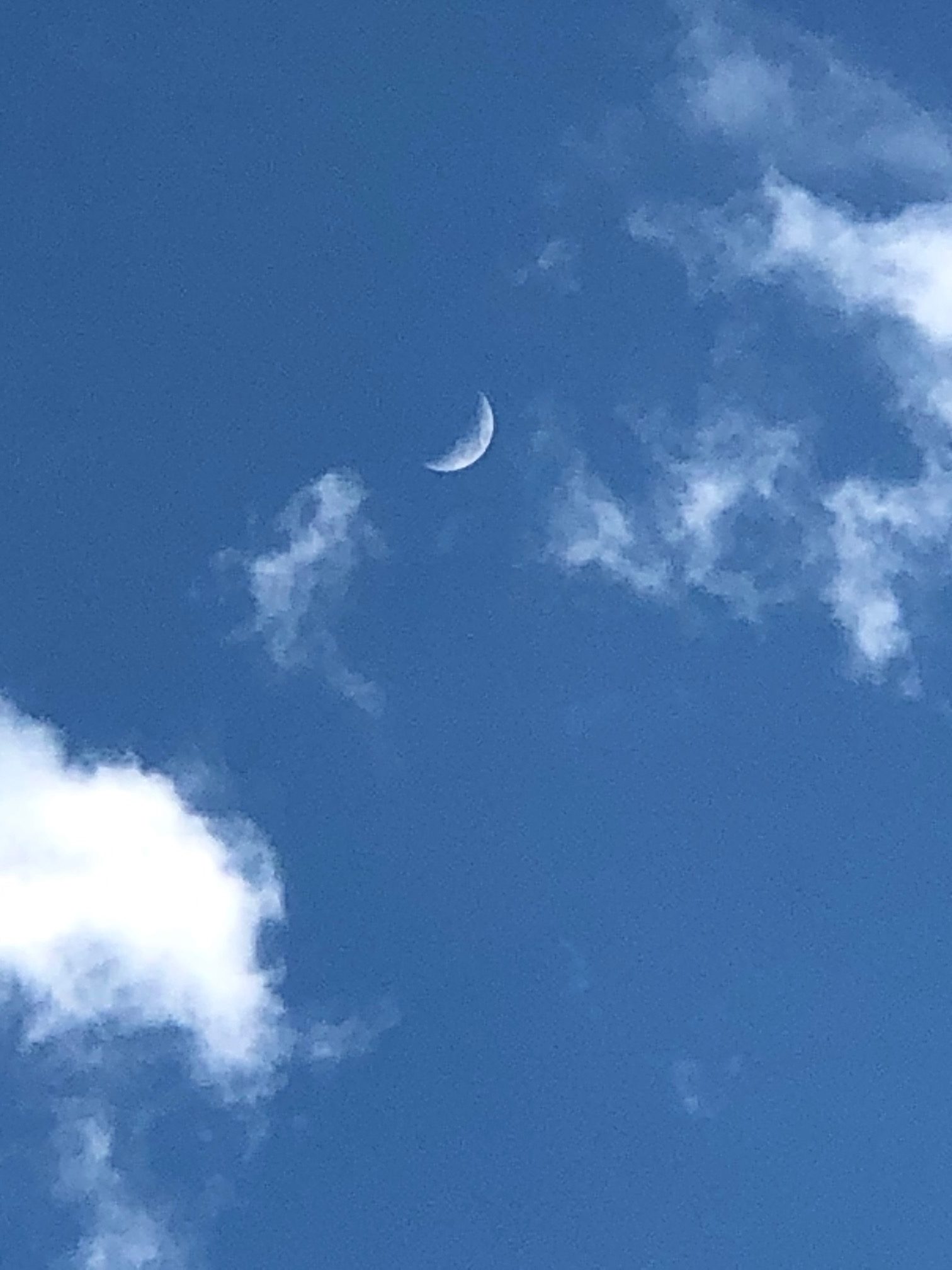
Look to the skies for guidance on how to remain detached and yet fully energetically connected!
– Photo by Jan Ketchel

The key to actualizing our human potential is energy. If you have enough energy you can do just about anything. Recognizing the value of conserving and retrieving energy, shamans discovered that the human being’s most lethal energy drain is offense.  Being offended, by anything and everything, costs humans the lion’s share of their vital energy.

When we feel offended by the words and deeds of others we have emotional reactions, like anger, fear, and resentment that tax the central nervous system. We lose our balance, as we become emotionally charged, seeking relief in some kind of action. Often, obsessive thinking continues to replay the offense, which sustains and feeds this state of emotional tension.

Is it possible to have an objective reaction to another’s offensive behavior without being personally offended? Yes, through gaining conscious control of our instinctive emotional reactions and deciding, on the mental plane, to not be offended by the behavior of others, regardless of how ruthless it might be.

Who could forget Robert De Niro’s “Are you talking to me?” in the movie Taxi Driver? Instinctively, we feel the growing tension of his mounting anger, as he incessantly repeats this famous line. Truthfully, many are drawn to such unabashed expressions of rage and contempt, which vicariously satisfies our own unexpressed rage and resentment.

Now, if Robert De Niro had simply walked away, the movie would have flopped. On the other hand, if we want to start saving our vital energy, we must be willing to let go of the many dramas our internal dialogue ignites through its constant interpretation of offense, throughout our everyday lives.

This is not to say that there is not significant horrific behavior that must be addressed. At issue is the subjective state of offense that accompanies one’s reactions to those behaviors. One can assess a situation and decide upon a course of action, unencumbered by emotional reaction. In fact, this is a core teaching of all martial arts.

When one becomes emotionally offended by an opponent’s move, one loses one’s edge, fights poorly, and generally loses. As in shamanism, in the martial arts the key to success is to not become attached —offended— by one’s opponent’s behavior. The objective is to stay present to what is and completely conserve one’s energy in order to be fully engaged in one’s most efficient counter response.

In fact, when one becomes offended one actually gifts the opponent one’s own energy. Offense can lead to hopelessness, powerlessness, and surrender, as one’s vital energy reserves become depleted. Bullying behavior is actually a strategy to catch one’s opponent in the net of offense, weakening their game. Muhammed Ali was a striking example of such tactical behavior leading up to a fight, as he would mercilessly insult and demean his opponents.

Instinctive reactions can be, and often are, life saving. What we take as an instinctive reaction, however, is very frequently the ego’s decision to be offended, whereby calling forth the troops of passionate reactions to exact retribution, in some form. This is a hybrid, instinctive reaction that serves only the ego, not the true needs of the self.

Ego must learn to be a servant to the true needs of the whole self, rather than just its own self-aggrandizement. Even if the ego has been directly insulted, the ego must consider the energetic impact on its central nervous system, and its energy reserves, before determining its course of action.

If the ego faces the fact that we live in a world where life feeds upon life, it can come around to the fact that we live in a predatory universe and not get offended by it. Of course, this does not stop our need to defend ourselves, but how much stronger and more clearheaded we would be if we didn’t burden ourselves with being offended.

When the shamans speak of detachment, they are targeting what we typically judge to be offensive behavior. They promote inner silence to avoid offensive dramas when navigating oncoming time, to best be prepared to respond appropriately, with the least taxing of our energetic reserves. Inner silence entails quieting the mind, pulling into the heart center, and waiting patiently for the guidance that shows us how to act in a way that is truly right.

In addition, they recommend a thorough recapitulation of one’s relationships in life, particularly circumstances that left one feeling offended. Recapitulation frees one’s energy stored away in offense, but also frees one from being triggered by current circumstances that reflect one’s unresolved past.

The truth is that there are highly sadistic, abusive people who commit horrific acts. Recapitulation does not change this fact, but it does free one from draining one’s vital energy by being eternally offended by them. Detachment means accepting the truth of what was, and fully harnessing one’s freed energy to be redeployed in new life.

I send out the intent for unbending detachment, as we collectively advance our world into new life, beyond offense.

With Unbending Detachment,

Chuck

Chuck’s Place: Capitulate

Time for Shadow Reckoning…
– Photo by Chuck Ketchel

Ego is at the center of the conscious personality. Ego exercises the light of consciousness, which enables choice. Ego is part of the divine consciousness but experiences itself as an orphan, charged with the task of navigating life.

Ego wears a mask, as it embraces a persona, to become acceptable to the world. Often, that which is unacceptable in the self is moved by the ego into the subconscious, where it develops into a hidden character, called the shadow.

The shadow holds views with a passionate vigor that often threaten to overwhelm the ego’s executive ability to suppress. The collective shadow of a nation houses views that may seem anachronistic to modern times. The Black Lives Matter movement, for instance, shines a bright light upon underlying racist beliefs and policies that control modern behavior.

Thus, at a subconscious level, the Civil War was never completed. Much the same can be said of WWII, as we see a major demonstration of  Naziism in current day Germany. The burgeoning energy of the collective world shadow, generally held in check by leaders who model morality and responsible behavior, is instead being invited to exact its toll on the very fabric that holds modern civilization together.

From the Hindu perspective, we are currently in the final stage of Kali Yuga, the time of passionate breakdown of civilization. Thus our world is currently in its autumn season, with its inevitable capitulation to death and resurrection.

The unsettling impact of shadow eruptions, acted upon the world stage, reflect the necessary encounter with all that truthfully is, including the known, the suppressed, and the deeply unknown of the repressed. For new life to form, all the hidden pockets of self must be known and reckoned with. These are exposed in the many dreams of excrement and broken toilets that many spiritual seekers must encounter on their journey to truth.

Fortunately, though ego is greatly impacted by its shadow passions, it retains the potential to face the full truths of all that it encounters, within the self. Ego can also withstand becoming identified with, and controlled by, its shadow personality, as it nonetheless listens to and attempts to resolve the challenges posed in an honest reckoning with its shadow.

Ego is tasked now with facing its shadow. The divine cannot be accessed through the veiled distortion of identity created by a personality that does not know its shadow. This is the value of the time we live in. The shadow is being completely outed and experienced. What remains is full reconciliation with shadow, so as to depotentiate its fury and fully integrate its value.

When ego has squarely faced and reconciled with its shadow it is fully poised to receive truth, the hallmark of the divine. From this place, the High Soul can be openly channeled by the ego, as it capitulates itself to manifesting what is truly needed in the world.

Capitulation is not surrender, it’s maturity. When one encounters the real truth, what higher purpose could there be than to serve its intent? Beyond the cauldron of now is the transformation of human life into a new personality construction, where ego capitulates to the guiding truth of the High Soul, who awaits its arrival at the heart center.

As within, so without. Be empowered. Reckon with the hologram of the self. Facing the personal shadow is also reckoning with the collective shadow that we are all a part of. Capitulate to the greatest task of all: owning and transforming the shadow, that the light might truly enter the soul.

Capitulating,

Chuck

Chuck’s Place: The Turning Point

No Pipeline!

On Sunday, The Atlantic Coast Pipeline, a project that threatened the sanctity of life on Roberts Mountain, was cancelled by its sponsoring companies. The impact of the coronavirus creating a world energy glut laid bare the truth that the cost of fracking and transporting natural gas via the pipeline was a financial absurdity. Even the recent Supreme Court decision to remove all regulatory roadblocks to the pipeline could not justify this 8 billion dollar project to its investors.

In our joy, Jan and I clearly realized that the world is now in the time of the Turning Point, hexagram number 24 in the I Ching. The corporate  decision was announced between thunderstorms. The Turning Point is composed of thunder beneath the Earth. Five Yin lines rest upon a Yang line at the bottom of the hexagram. The energy of new life is stirring in the Earth, and the heart. The Turning Point is the first substantial sign of long-awaited change; may it be handled with care. Here are the I Ching’s cautionary guidelines, interpreted from and with my personal insights:

Nine in the first place: To stray from the truth of the heart in small digressions is natural, however, be sure to turn around before a habit is formed. If one is enlightened of one’s illusion, shift position and embrace the truth. No shame is attached to abandoning that which does not serve the high Soul or the common good.

Six in the second place: Here the ego is encouraged to quietly subordinate itself to the truth of the heart, the intent of the high Soul. “Quiet”, writes Aurobindo (Powers Within, p. 120), “is a condition in which there is no restlessness or disturbance.” Ego is deeply calm when it acts upon its true vocation, the intent of its high Soul. Meditative practice that masters the automatic reactions of the autonomic nervous system can support this relationship.

Six in the third place: Here we encounter the Sisyphus of constantly doing that which I would not. These are the reversals of good resolutions brought on by the desire body’s influence upon a receptive ego. Ultimately, this is not a disaster; one simply will have to do it over again until one gets it right.

Six in the fourth place: Stay connected to your inner truth. We are surrounded by contrary views and the opinions of others. The power of true connection with one’s high Soul is the only friend one will ever need. There is no need to prove anything to anyone, proof rests in the knowing heart.

Six in the fifth place: Assume responsibility for manifesting your high Soul’s intent for your life. This requires deep self examination and honesty on the part of the ego. Admitting and relinquishing one’s attachment to illusions frees tremendous energy for one’s true mission, the intent of the high Soul.

Six at the top: Beware of blind obstinacy, it leads to misfortune. Refusal to answer the call of the high Soul ensnares one in an ever-deepening rift from right action; a slippery slope into the abyss. Mortality has its limits.

In summary, the time of the Turning Point is most auspicious. The underlying burst of energy to initiate change has arrived. However, as the guidance emphasizes, much effort in shaping needed change rests in the hands of the ego, which must first and foremost wrestle with its humanness.

Humanness is often governed by the inherent archetypes, the ruling parents. We are all children of those archetypes, charged with transcending their governance through arriving at right action, rooted in the truth of the heart center.

Nature is providing us with the thunder, let’s use it wisely.

At the Turning Point,

Chuck

Chuck’s Place: Encounter with Other

Other…
– Photo by Jan Ketchel

Other, is a separate reality. Other is life in dreams. Other is life in a body. Other is life beyond reason. Other is shadow. Other is other.   

Beyond the protective narcissistic wrapping around self lies other, waiting. This narcissistic sheath serves to homogenize other, blending it for inclusion within the familiar comfort of self, a far cry from true encounter with the mystery of other.

The internal dialogue immediately snatches the waking ego to erase its  dream encounters with other. To connect and journey with other from dream, threatens the ego’s hegemony over its world. To include other would require ego to take in a world far greater than its solid grasp on reality.

Even if the ego takes up the dream, it quickly formats it into the known; all characters fit into associations that lead back to parts of the self. Reason ensconces encounters with other safely within the boundaries of known self, reinforcing all the usual dramas. From here the internal dialogue paints the day, a portrait of self, everywhere.

Reason cannot permit the mystery of other. Though drawn to the magic, it pummels it into logic, sneering smugly, as it brands it childish fantasy. All that is known is provable in experiment, repeatable in the light of day; everything else is fantasy.

Characters in a dream are merely the byproduct of neurotransmitters active in the brain, says reason, just as it judges out-of-body experience to be merely dissociative hallucination. How reassuring for ego to transpose the irrational into order. How protective of self to resist the delusion of other.

That which is not-I can shatter one’s world. Perhaps its worldview is far more comprehensive; suddenly one is nothing. Perhaps one doesn’t feel worthy of other; other will never show up. Longing for other, one hides in excuse.

Perhaps the greatest challenge of our time is our reason’s encounter with the irrational other. So complacent we became with the dominating all-encompassing rule of reason that we dismissed the power of nature, whether in the form of a coronavirus, or an emotional virus, that now holds reason in its grip.

Clearly, reason must accept the power and autonomy of this  irrational other. Denial has led to this compensatory rise of impulse over science itself. Modern humanity is responsible for this uprising because it embraced reason alone as its one true god.

Suspend judgment, get to know the fullness of other in one’s whole self. Take up the challenge of life in the dream. Get to know and fully live in the body, as well. Connect with the universe in the synchronicities and agreements that saturate every moment. Talk to the plants, the birds, and the bees.

Encounter other with openness, respect, and loving kindness. That’s how the world will heal. 

Encountering other,

Chuck