Tag Archives: mindfulness

A Day in a Life: Poison Ivy As A Mindfulness Practice

We can’t stop nature from doing what it will and so we must learn to flow with it, to take action to protect ourselves within our knowledge of how nature works. On the other hand, we are responsible for what is happening in nature now. Although we are not directly responsible for thunderstorms, lightning strikes, tornadoes, hurricanes, earthquakes, etc., there is plenty that we, the human race, have, by our very existence, altered forever on this planet. One of those things is poison ivy.
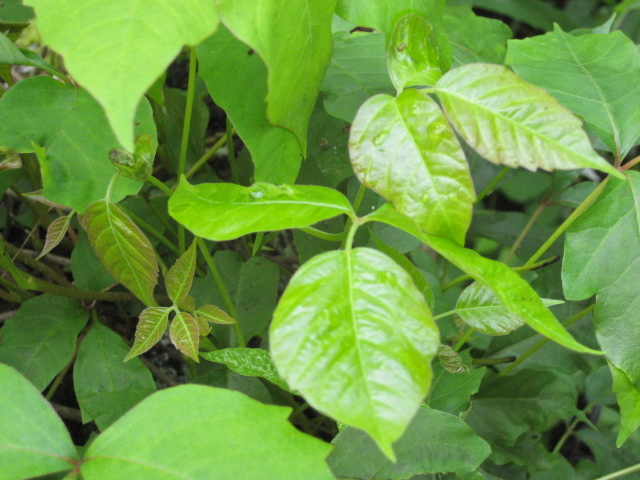
Leaves of three, let it be...

Several years ago, I heard a report on NPR about the proliferation of a new strain of poison ivy. This strain, I heard, was more potent than the kind of poison ivy I remember as a kid. This new strain of poison ivy grew into trees, as tall as six or ten feet, and it could kill. Now that was alarming to hear!

Having grown up in a rural environment, I learned early what poison ivy looked like. I knew its reddish hue in the spring meant beware, and I also knew that its bright green leaves later in the summer meant stay away. I had an eye for identifying plants early in life—it was just a knack. I knew to stay away from the flowers and berries of deadly nightshade from the time I was small and I’d often warn my friends that something was dangerous without even knowing how I knew it. I’d thought about becoming a botanist at one time, so fond and curious was I of what grew around me. Instead I became an illustrator and did, on many an occasion, get to draw the intricacies of the plant world for one book or magazine article or another.

If I got poison ivy, it was normally a minimal rash, easily dealt with. I never got covered like some people. I didn’t seem especially allergic to it, though I knew not to fool with it either, not to rub it or scratch, but to wash the oils off as soon as possible and let it dry out. I’d cover it with calamine and let it be and before long it would dry up without too much discomfort. I remember as a little kid having it on my face and at the time I just could not help but scratch, and boy did I suffer, but that also taught me a lesson. After that I learned to bear the tension of the itch and just get through the pain that nature itself had inflicted on me, knowing that it would soon be gone. That being said, even I was recently fooled.

One morning, Chuck and I were sitting in the yard enjoying a cup of coffee when I felt an itch. Thinking a bug was crawling up my arm, I lifted my sleeve to discover that my entire arm was covered in an ugly rash. “Oh my, look at that! Poison ivy! Where did that come from? I’m usually so careful!” I said. By the afternoon it had spread. Another, less vicious looking rash showed up on my other arm, my stomach broke out in angry red spots. Later an itch on the back of my neck showed up, another behind my ear, and was that one by my eye too? Suffice it to say, I had a bad case of poison ivy.

“This is exactly what I’d heard about years ago,” I said to Chuck, “poison ivy in a new, especially toxic strain, and it looks like I have it!”
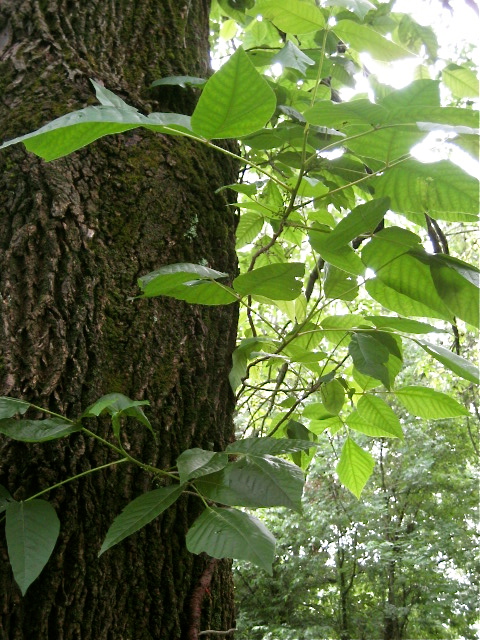
Poison ivy: Global warming in our own backyard...

In reading up on that new strain of poison ivy, I note that in the few years since I first heard about it, its notoriety has spread along with it. Now it’s certain that we are largely responsible for this new potent strain of poison ivy, and there is no longer just one new potent strain, but many. The vines are rapidly spreading and the resulting contact itch much more difficult to treat.

With global warming has come an increase in carbon dioxide in the atmosphere, a trapped greenhouse gas that is especially well liked by vines, especially the two that we see in the Northeast: Virginia creeper and poison ivy. That’s another thing I noticed not long ago. When I was a kid, Virginia creeper did just that, it crept along the ground, the floor of the forests covered with it, but I rarely saw it climbing trees the way it does now. Now both Virginia creeper and poison ivy, along with a host of other carbon dioxide-loving vines, are climbing higher and higher, overtaking other vegetation, seriously affecting the survival of our forests. Apparently this new poison ivy—that is rapidly inhaling our humanly-induced increase in carbon dioxide—carries a more toxic form of urushiol, the oil that causes the pesky itch.

As soon as I saw how quickly the rash was spreading, I knew I was in trouble. This was no ordinary case of poison ivy, this is what I saw on other people who were highly allergic, this was serious. I took immediate action. Changing my clothes, showering, and dousing myself with calamine and taking homeopathic rhus-tox were the first steps. Careful not to aggravate it, I let the rash air dry as much as possible, but it got worse. And then it got even worse. Now covered in angry blisters, I constantly had to fight the urge to scratch.

Now, anyone who has had poison ivy knows that there is nothing more satisfying than giving in to the urge to scratch away. Boy does that feel good! On the other hand, no amount of scratching will ever relieve the suffering, as scratching only spreads the rash and calls for yet more scratching.
The urge to scratch...boy does that feel good...

I found some relief in showering frequently, vicariously experiencing itch relief by letting the hot spiky water from the shower head do the scratching for me. I soon found that this was not a good idea, the heat of the water actually opening my pores to more of the poison. I knew I had to “grin and bear it,” as they say. I would not scratch in any way. I would use the itchiness to go into stillness. And so began my week of deepening my mindfulness practice, with poison ivy as my guide. In so doing, I learned something new about myself and each time I learned something new I took it deeper, intent on learning something else, not only about myself, but also about the greater world that I live in.

I’d wake up at night itchy. Surely a tiny little scratch here or there won’t hurt? Don’t do it! Bear the tension. Let it be. Go into meditation. Go beyond the skin. Go deeper inside. I will not scratch because I do not itch. I do not feel itchy at all. I am the Buddha. Flies are landing on my face and yet I do not flinch. I am the Buddha. Mosquitoes are buzzing in my eyes and yet I simply ignore them. I do not give them any energy. I am the Buddha. The snake is coming closer in the grass and yet I am not afraid. I sit in stillness and I disappear. I am the Buddha. In stillness I do not exist in this body. I am merely energy and thus the sensations of this body are meaningless. I can let them go.

I gradually leave my itchy body behind as I do this mindfulness practice, successfully removing myself from it enough as the night goes on that eventually I don’t attach. In the morning I wake up tired, but I have succeeded in avoiding the deathtrap, the itchiness that invites me to partake in the vicious cycle of relief and more agony, relief and more agony. I avoid the cycle of samsara, suffering, for one more night. And I must continue this practice during the day as well. I must not lift my hand to scratch behind my ear. I am the Buddha. I must leave my hand down, sit with the sensation, detaching from it, cooling it with my thoughts at the same time that I seek external remedies for my suffering.

Like the Buddha I must suffer through the onslaughts...

I suffer through five days of extreme discomfort before the rash subsides. Chuck looks at it one day and declares it done. I’ve conquered it. There is still an occasional itchiness, but the blisters have dried, the redness has diminished, the spread halted. I have learned what it means to suffer through an onslaught of nature, a manmade disaster as I now see it, and I hope that others may come through such an attack in good form too.

My mindfulness practice with poison ivy as my guide led me many places, to many journeys within and without, to greater understanding and acceptance of my role as a user on this planet. The world is changing and we are largely responsible for many of these changes. That is clear to me now. Every one of us, by our very breathing, effect and are affected by these changes. Whether it’s a bad case of poison ivy or a nuclear disaster like Fukushima, we are all part of the problem and we will all suffer, our bodies especially.

I had to ask some hard questions. So, how are we going to handle the inevitable crisis we have inflicted on ourselves? Are we going to make it worse by scratching and complaining about others, about the poisons put into our atmosphere by others? It’s easy to give up, to indulge in bad behaviors, to wallow in self-pity and to blame. It’s much harder to take full responsibility and change ourselves.

The challenge we face now is to accept what our human greed has done and—in full knowledge of our personal participation in the disasters we create and continue to create—take everything to a new level. We must accept our human limitations and work to deepen our connection to our energetic selves, personally and as an interconnected species, taking everything far beyond the human energy that we so value and indulge in to a greater understanding of our energy as no different than that of the fly or the mosquito that pesters us. We are all life’s energy having experiences here on earth.

Everyday now, I accept that I am part of the changing world. My mindfulness practice has deepened my awareness of what it means that I live here too, that I impact everything too. I too have poisoned the fish in the ocean. I too have dirtied the waters and contaminated the soil. I too have contributed to the greenhouse gases. I too am responsible for the wars and the terrible massacres that are happening around the globe. I too am an abuser. I too am greedy. I too am an addict.

I cannot change what has happened. It has already happened. The only thing I can do now is, from this moment on, make a decision to live my life differently, with awareness and mindfulness, committed to making better personal choices. The time of change is now. 2012 is upon us and, by the potent state of things, has been for a long time. Are we going to stay splintered, unaccepting of our personal human role in all of this that we have created? Or are we going to each individually take the next step to deepening our interconnected awareness and really changing ourselves so that we may change our world too? That’s the only challenge I see ahead of us now.

The earth will survive, but I don’t think we, as a species, will—unless we take some drastic measures to insure that our planet will be able to support us. With even the most basic requirements of air and water in jeopardy, let alone everything else we need to survive in even the most primitive conditions, how do we expect to evolve as a species?

I challenge myself to constantly create better balance in my own life while seeking to live in greater harmony with the world I find myself in.

In humbleness,
Jan
A Day in a Life: Peaceful Mind

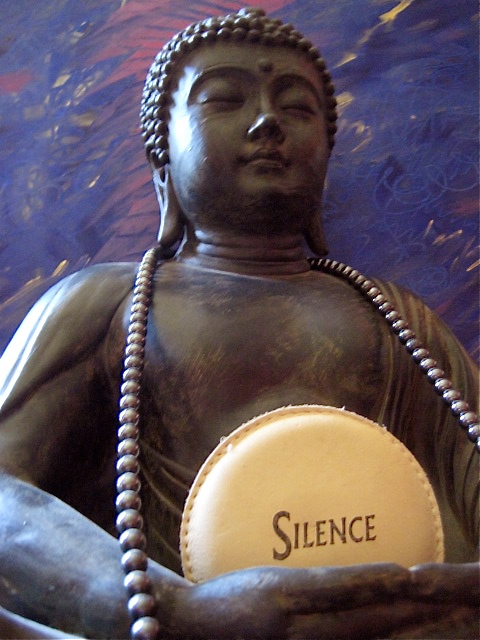
So Chuck and I have lately been writing about mindfulness meditation with the goal of achieving compassion, for ourselves and others. We both spent some nights dreaming with the Dalai Lama, thought to be the incarnation of the Buddha of Compassion, and indeed his life has centered on bringing the concept of compassion to the modern world. But what about mindfulness, what is it and how does one achieve it?

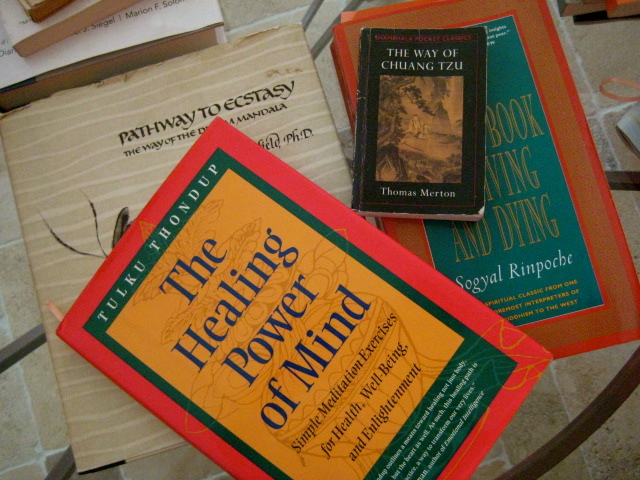
Some mindful reading aids...

I like to think of mindfulness as a practice of achieving a peaceful mind, the true nature of mind. By constantly reminding myself that my life is a journey, and by acknowledging that everything that happens in a day and in a lifetime is an important part of my learning experience, I am able to bring myself closer and closer to achieving the goal of peaceful mind. Sometimes I get there for long periods of time, and other times I may only touch down for a few minutes a day, but the more I remind myself of my goal the easier it becomes to quickly experience peacefulness of mind.

Even during recapitulation, when in the throes of a memory, one can use the practice of mindfulness to ground the self and stay in the adult present self. Reiterating often that life is a journey of self-discovery helps anchor one in reality, even while another part may be experiencing something from a painful past. Mindfulness is that anchor, the anchor of awareness that we are all on journeys, that we are all in our lives to learn something, that we are all sentient beings capable of incredible feats. The first incredible feat is to remember these things, to change how we think about ourselves and our lives by constantly bringing our attention back to these truths. The second incredible feat is learning to let go of what normally fills our minds so that we can rest a moment in the peacefulness of empty mind. Mindfulness is building awareness of ourselves beyond the usual cogitations of the mind, awareness that the perfect state of mind is peaceful. It is what our minds seek most of all.

It is possible to begin training in mindfulness simply by bringing attention to what we are doing throughout the day, staying mindful of the moment. In such mindfulness practice peace exists. Now I am mindful that I am sitting at my computer and writing, but I am also mindfully aware of my breath, of my calm heart, of words flowing out of me.

Calm and empty peaceful mind...letting thoughts go...

In a little while I will make a cup of tea. I will sit calmly with my tea and drink it mindfully, focusing on its nourishment, letting thoughts go as I remind myself that “I am drinking tea, I am drinking tea.” When I take a walk, I remind myself that “I am walking now, I am walking.” I focus on my breathing and my next step, letting thoughts go. As thoughts return, as they always will, I simply bring my attention back to what I am doing. “Oh, yes, I am walking!” When I go to yoga class I calm my mind by saying, “I am in yoga class now, I am present in my body in yoga class.” I constantly remind myself to come back to the moment, to where I am and what I am doing in the moment. In so doing, I allow all else to escape the confines of my mind, leaving room for a few moments of empty, peaceful mind.

This mindfulness practice of constantly re-anchoring in the moment, aids in allowing worry and stress to be absent, however briefly. Given a reprieve it will often leave of its own accord, for in reality it does not exist if we do not give it a home to exist in.

Begin the process of mindfulness meditation in everyday life simply by being in the moment and then re-focusing on being in the moment. It doesn’t need to be something that we sit and do at a certain time each day, though that is perfectly acceptable too. In the end, by simply allowing it to become a natural part of everyday life, it grants us its gifts more frequently. By constantly reminding ourselves to be mindfully aware, we train our awareness to be mindful more often and pretty soon we find that it comes to our rescue when we most need it, such as in a moment of intense recapitulation as I mentioned.

Being able to anchor ourselves in the awareness of now, reminding ourselves of the truths of our journeys upon this earth and the desires of our spirits to learn and grow, helps greatly as we face our recapitulations. The more we are mindful, the easier it becomes to be mindful again and again. One day we might notice just how peaceful our minds are and, however brief the moment may be, take it as a sign of achieving the goal of mindfulness.

Empty mind...

With mindfulness comes compassion; it just naturally seems to lead the way there. We find that compassion does not really need any explanation. One day we just find ourselves experiencing it because we have already taken on the biggest enemy of compassion: the old mind with all of its directives, judgments, condemnations, repetitive voices and tiresome criticisms. By letting it go we become open to new ideas, new thoughts, and incredible feats of mind never before thought possible. One day we find that all of our thoughts are compassionate ones, all of our ideas embrace a new paradigm, encompassing a broader worldview where everyone is equal.

By opening the mind to peacefulness we allow new energy in, and it comes in calmly, aware that something is different now, that the mind is no longer accepting the old way, for it is only interested in peaceful emptiness for all.

Peace,
Jan

Chuck’s Place: Hello Lucky!

Evolving dream mandala...

Jan and I spend a full night in dreaming with the Dalai Lama. The actual practice incorporates waking and sleeping. With each waking, a quarter turn of the body into the next quadrant of the full circle of sleeping positions is made—from side to back to side to stomach—as the night goes on. With each turn there is a return to sleep for further dream teaching, as the unfolding mandala of our dreaming progresses.

At the end of the night the Dalai Lama is dying and I anxiously ask him who will be his successor, the next Dalai Lama. Secretly, I hope it will be me!

Finally, the dying Dalai Lama turns to me and says: “My successor will be LUCKY.” And with that he dies.

Earlier that evening, Jan and I had watched an interview with the Dalai Lama conducted by Arianna Huffington on the steps of St. Paul’s Cathedral in London as he celebrated the Templeton Prize, awarded to him for his decades of focus on the connection between the investigative traditions of Buddhism and science, seeking to advance the world.

In his somewhat challenged English, the Dalai Lama talked about the reality of neuroplasticity, the scientific validation of real growth and alteration in the brain directly caused by the practices of mindfulness meditation and compassion. The brain grows by developing new regulatory circuits leading to deep, contented calm through these practices.

The Dalai Lama downplayed religion as a catalyst of change, even suggesting that religions will never agree. On the other hand, science, he said, validates that we can change ourselves, and our planet, through the practices of mindfulness meditation and compassion for all beings. Through these practices, inner peace is achievable, with the added benefit of relieving the environment of the burdens of our over-consumptive attempts to soothe ourselves by other means; using drugs, alcohol, etc., combined with our desires for material goods and comforts that, in the end, have little real meaning but greatly impact our human potential and the earth.

Try a little meditation...it's not that hard

The Dalai Lama decided to award the 1.7 million dollar Templeton Prize to the Save the Children Foundation. He envisions a movement to teach compassion and meditation to children in school, at an early age, as a foundational way to balance young minds and change the world.

So, who is LUCKY, the next Dalai Lama?

In researching the meaning of the word “luck,” I was struck by the juxtaposition of two worlds—spiritual and scientific—in its meaning. The spiritual dimension suggests that luck is prescribed by supernatural or spiritual forces that cause fortuitous events. From a scientific perspective, luck is a random or fortuitous event that is willfully generated or logically explicable. Since spirits can’t show up for scientific method, they can exist only in science fiction, not hard science. However, the results are the same: something happens!

So, my dream Dalai Lama, as well as the living Dalai Lama, while acknowledging a spiritual dimension, lays emphasis on generating luck—LUCKY—through hard science. He points out that neuroplasticity is hard science. Neuroplasticity, with its contented neural pathways, generates GOOD LUCK! He tells us not to bother with spirituality but to instead engage in practical science: Change the brain through mindfulness meditation and compassion and bring LUCKY to life!

LUCKY is the end of a singular line of Dalai Lamas. My dream Dalai Lama tells me that we are all LUCKY if we are willing to engage in the practice of mindfulness meditation that leads to pure compassion. Compassion is first discovering the Buddha or Lucky One in the Self, then seeing the Buddha—or LUCKY—in everyone, using mindfulness-based meditation leading to compassion.

Just Mr. Potato Head or Lucky?

I am awestruck at how the ancient family trees of Tibetan Buddhism and Carlos Castaneda’s line of Shamanism have evolved from their homelands into Everyman’s Land. Castaneda ended his line of shamanism in its traditional format by launching the practice of Tensegrity and introducing the idea of the new Nagual in all of us. My dream indicates that the Dalai Lama’s exodus from Tibet, with Buddhism’s diaspora throughout the world, offers us all the opportunity to be the next Dalai Lama, if we follow the scientific practice to grow our brains through neuroplasticity into LUCKY, the compassionate beings we truly are. These are the offerings of the ancient roots of these traditions: we are all embodiments of Buddha, the Nagual, God.

Where these two ancient/modern traditions converge is in the practice of recapitulation, either through using the ancient magical passes or in a mindfulness meditation practice, as the present self takes the full journey to change through revisioning life lived. These evolutionary practices of change promote brain growth—neuroplasticity in action—offering the circuitry for the real experience of compassionate detachment with love. Ultimately, finding the pathway to true compassion means being able to find the Golden Buddha in even the cruelest of tyrants.

In the end, aren’t we all LUCKY?

Chuck

Chuck’s Place: Strengthening The Present-Adult-Parent Self

Meet present-adult-parent self

The present self is our conscious self, the self we have forged through the years of challenge of life thus far lived. The present self is an evolving self, a self that grows as it forms relationships with parts of the self that live outside of consciousness and as it integrates long forgotten or stored away parts of life experiences into consciousness. The present self also grows as it takes in knowledge and experience from the outside world that broadens its ability to navigate life.

The present self is therefore our most adult self, the most grown-up part of our self. This is also our true parent self, the self we trust to keep us safe and secure, and to make the myriad of decisions that guide our actions each day.

The present self is essential to recapitulation. When life events trigger the surfacing of traumatic material, it is the present self that must take up the challenge. Very often the triggered material is extremely emotionally charged, threatening to overtake our calm, our focus, and our ability to stay present and in control. When triggered, we might become overwhelmed by debilitating psychosomatic symptoms, like extreme pain. We might suddenly find ourselves outside our bodies, viewing life at a great distance. We might also become overwhelmed with nausea, dizziness, and the growing feeling of disintegration.

The ultimate goal in recapitulation is to fully relive an experience with the full presence and attunement of the present self. This ability to remain fully present through an experience that once overpowered and fragmented the psyche is a major step toward stripping the experience of its disruptive power and beginning a process of integration that eventually renders the experience emotionally neutral, becoming a significant but now non-disruptive fact of life lived.

During the recapitulation process, the present self becomes the parent we never had, the one that can hear and feel the complete truth without judgment, as we identify and release our myriad of feelings frozen in the memory. Our grown-up, adult self helps us sort through our confusions as we continue to unravel what really happened in the incident under experience.

The key to this healing process is not recovering lost memory. Memories will come of their own accord, either through triggers or intent. The most important factor in recapitulation is the ability and strength of the present self to stay present and receive the emotionally charged lost memory as it arrives. For this, we absolutely need our present self to be the adult, the parent we can trust to see us through the journey of recapitulation and recovery.

Centering

We strengthen the present self through mindful practice. Mindfulness asks us to gently and persistently practice centering and returning our awareness to our place of inner calm. That place is unique to each person. For some it may be in the heart center, for others in the feet, and for still others in the vibratory sounds in the ears. Some find that calm in their breathing, others in images of safe places or in mantras and prayer. Mindfulness practice asks that we train our awareness to increasingly find its way back to our calm center as we navigate through all the events of daily life, whether taking a shower, walking, driving, eating, working, sleeping, sitting alone or in company.

Constantly, but calmly and gently, we notice where our awareness has strayed. We acknowledge what it has landed on, and push nothing away, but neither do we attach or continue to freely associate. Instead, we gently return our awareness to our calm center and engage in calmness. And, in so doing, we strengthen our ability to find home base again and again.

By constantly anchoring in calmness we develop and strengthen the ability to stay present and observant, to feel but not be submerged when infinity decides its time to present us with a golden moment of recapitulation, asking us to retrieve and free another lost part of ourselves. Though dizziness, disorientation, and emotional tsunamis may ride in on its wake, our present-adult-parent self remains fully present and attuned, tracking the unfolding storm like a keen observer, seeing the fuller picture for the first time. The present self stands by the younger self, modeling the ability to bear the full intensity of the recapitulation experience, as the fears and anxieties that have held revelations in check are dismantled and the truth is revealed.

In full awareness, the present-adult-parent self, well trained for just this moment, listens and clarifies for the younger self all its confusions about what really happened and why. Clarity brings understanding, as shame and blame are replaced by acceptance of the massive challenge once encountered by the younger self. This is what happens during a recapitulation experience when the formerly frozen, split-off younger self is securely welcomed into the arms of the evolving present self, released now to enjoy a fuller, more complete life.

Mindfully view, listen and clarify

Mindful practice is an ongoing practice that is available to the present self at any moment of the day. We needn’t wait to set time aside to practice, though that kind of discipline is also valuable training. However, for all practical purposes, we can practice mindfully throughout the day by simply bringing our awareness to our calm center over and over again.

Each morning as we arise, we might pause and ground ourselves before we start our day. As we go about our morning ablutions, eat our breakfast, plan our agenda, go into our work day, make decisions, daydream, ruminate, obsess, we might suddenly become aware of where our awareness has strayed, gently acknowledge it, and invite it back into our calm center, even if only for a moment. This is mindful practice. Each time we do this throughout our day, we strengthen our present-adult-parent awareness. Eventually, seemingly without effort, we find it fully present and ready for its encounters with infinity, as it comes beckoning us into recapitulation and evolution, enticing us always toward greater wholeness.

From that calm center,

Chuck

Chuck’s Place: Practice Inner Silence

In meditation we learn to master our awareness. The mind is a powerful thing, a think tank that never stops. When we meditate we are confronted with the products of this ceaseless mind engine: thoughts.

Thoughts approach our awareness like vendors selling their wares on Black Friday, sales people lobbying for our attention. And just like the freedom we exercise to buy or not to buy, we have the inner ability to attach or not attach to a thought. If we attach we spend our inner capital, our energy, on the thought by giving it our attention, letting it unfold and journeying with it wherever it may take us. If we don’t attach we store our energy in deepening silence. When we surrender our awareness to the activity of the mind, we drift along on a current of free association, floating from thought to thought, our awareness completely captured by a mind-constructed world of thoughts.

With mindfulness we learn to exercise our innate freedom to attach or not to attach to thought. We learn to simply notice the inner lobbyists of thought, and choose not to attend to their wares. We decide to bring our awareness instead to our bodies—to our breathing, or to the sensations we notice as we scan our bodies in this moment.

When thoughts of varying intensities vie for our awareness, we notice them. We don’t struggle with them; we simply bring our awareness back to our bodies. In an instant we feel the vibration in our fingers or lips, or hear the sound of energy deep within our ears. We breathe; we are present. We judge nothing; there is nothing to judge.

Judgment engages the mind. It quantifies, rates, categorizes, etc. With mindfulness everything is equal, the same—no judgment, no distinction. Everything just is and we are fully present with what is without attachment.

Mastering awareness is staying present with what is, and freely, consciously, choosing where to place attention. We are no longer adrift on the sea without a paddle; we volitionally place our awareness where we want it.

If we are eating, we are not reading or watching—we are fully present in eating, in chewing, in tasting, with awareness. If we are walking, we walk without purpose or destination—we are fully present in our bodies, slowly feeling the sensation of connecting to the earth beneath us.

The shamans of Carlos Castaneda’s lineage practice magical passes to achieve inner silence. Fully mindful in their bodies, they engage the intent of inner silence and move in patterns discovered by shamans of antiquity during dreaming. These shamans don’t worry if they are doing the movements correctly. They suspend judgment and mindfully move. They know intent alone will correct the movements; they don’t fall for the tricks of the cogitating mind that seeks to interfere with the flow of silence.

Practicers of mindfulness and practitioners of shamanism alike are gentle but persevering in their practices. They know, as the I Ching so often states: perseverance furthers. Eventually, the mind desists and we become masters of awareness, fully engaged in our journeys. Without mind we experience total freedom.

Silence the mind, journey in infinity!
Chuck