Tag Archives: internal dialogue

Chuck’s Place: How To Assume Conscious Authorship Of Your Life

You are the Dream and the Dreamer…
-Artwork © 2026 Jan Ketchel

Carl Jung once had a dream where he was hiking in the mountains and came upon a Christian chapel. He went inside to discover a Yogi seated in a lotus position upon the altar.

As he approached he noticed that the Yogi was himself, Carl Jung, dreaming himself into physical life. Jung also had the clear realization that when the Yogi woke up his life would end.

This dream reflects the simple truth that some thought-centered part of ourselves is creating the physical life we are living. That thought center is the conscious mind that, through its suggestions to the subconscious mind, dreams us into our current lives.

When we fully become lucid to this basic genesis of our lives we are empowered to fully create the life we so desire. The hallmark of this technology is the power of suggestion to manifest physical reality.

Jung’s dream did not place Christ at the expected place upon the altar. Nor did it replace Christ with a Buddha. The central character was Jung himself, directing the show, in a lotus position, as his mind meditated on creating his waking life. Here the dream affirms that the power of creation is not to be projected beyond the self. The lives we are in are fully of our own creation.

By being shown this creation dynamic, Jung was empowered to take fuller responsibility for the direction of his life. One of his greatest contributions to achieving fulfillment was his technique of active imagination, where, through conscious interaction with dream characters, the conscious mind advances the health and healing of the self.

To actively imagine, still your mind and body into a calm state and turn attention to the dream scene or character you wish to engage, to either learn more from or have a different interaction than previously dreamed. State your intention to engage, and then wait, patiently.

The character or image may spontaneously arrive. Be with it and interact with it. Don’t feel pressure to create an interaction. Be with what is. It’s fine to allow yourself to imagine the changes you seek, fully feeling them to be real. Be accepting of whatever arises and know that your efforts are well received.

Going to sleep itself offers the ideal entrée into creating the waking life one desires. When we enter the hypnagogic state—where we are still awake but on the brink of dreaming, such that we slip in and out of it yet are still in conscious command—we have the greatest opportunity to influence the course of our lives.

What we feel and imagine at these moments powerfully impresses the subconscious mind, which then sets about bringing our intentions to life. The hypnagogic state is a time to exercise the psychic power of suggestion.

Neville Goddard introduced a practice he called revision of the day as one moves toward the hypnagogic state of sleep. The technique has one, in a restful state but before sleep, review the events of the day just lived, first completely forgiving oneself and others for any judged failures of self, or other, in events lived through the day being reviewed.

Next he instructs one to choose events from the day one wishes to revise, that is, to have lived differently. In the imagination, one revises these scenes to become the ideal one would have had them to be. These edits are then fully acted out in the imagination.

This revision is completed as the hypnagogic state gains the ascendence and the subconscious mind takes up these revisions as suggestions to manifest the desired changes within the self and toward others, just as imagined.

This then positively impacts the feelings and judgments one wakes up to; inner changes that free one from yesterday’s limiting habits. In waking life, the conscious mind can also purposefully change the habitual internal dialogue, to state the new “I Am” that one intends to embody.

Habits are efficiency shortcuts that the subconscious creates for ease of functioning in life. The subconscious will defer to new instructions to form new habits. Take command of the suggestive power of the internal dialogue to form desired new habits that manifest a changed physical reality.

If, for instance, the prevailing automatic internal dialogue states: “It won’t happen for me.” Counter that by stating incessantly: “It is happening for me, it has happened.” State these words hundreds of times each day, especially when the old script grabs your attention.

Remember, always: “In the beginning is the Word.” Use the words of your internal dialogue to edit and create your life, as you desire it. Then, let go into the knowing that your subconscious will publish your intended life story. Let go knowing that it will certainly happen, when and how is best.

Jung realized that his inner yogi waking up meant the end of his current life. When we wake up from the sleep of our habitual lives we can no longer live the old dream. This is the essence of death and resurrection. We cannot author the life we desire until we sacrifice the old habits that composed the old chapters of our life.

Use the tools of active imagination, revision and internal dialogue to thoroughly script that desired new life.

Wake up and live,
Chuck

NOTE: I have started a new blog called: Chuck’s Conversations with AI, which you can find under the Blogs tab in the top menu bar. Postings in this series are sporadic, as the spirit moves.
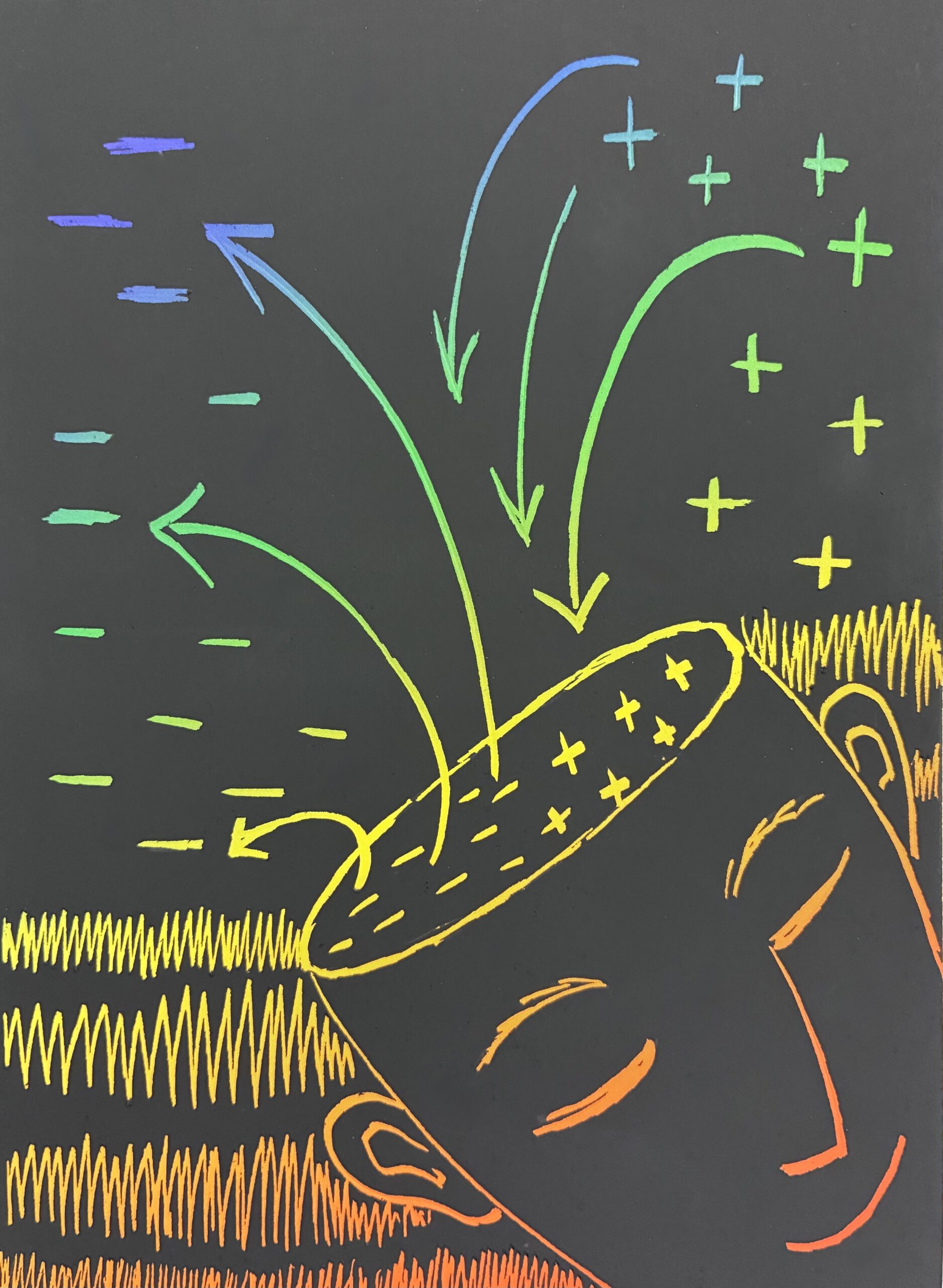

Chuck’s Place: Take Control Of The Internal Dialogue For Good

Out with the Negative, In with the Positive…
-Artwork © 2026 Jan Ketchel

The subconscious mind never sleeps. How could it, when it runs the physical body, and the energy body as well in its nightly journeys in infinity?

The conscious mind, by contrast, does nod off during sleep, and unless something wakes it into a lucid state while dreaming, it brings but vague downloads back to waking life upon awakening. Those downloads are known as dreams.

Actually, even in waking life the conscious mind can be said to be largely asleep. When driving a car, or performing a routine task, the conscious mind typically turns over the wheel to the subconscious mind that then steers the body and mind via the established programs stored within it, known as habits.

The conscious mind often takes flight into fantasy or thought until called back to task for necessary direction. When not mindfully present, the conscious mind is subject to an internal dialogue that is constantly defining and judging how it sees the world.

This judging activity actually creates the self and the world we live in through the consistency of its judgments and the personal identity it suggests to the subconscious mind.

Thus, for instance, the internal dialogue will deliver feedback every morning about the quality of one’s appearance during a quick or extended view from the mirror. It will remind us of unfavorable issues as it surveys its reflection, likely generating uncomfortable thoughts and feelings about ourselves.

Moving along, there are countless judgments about clothing, food decisions, and news and social media presentations that are categorized by such parameters as safety/threat, like/dislike, good/bad, positive/negative, approach/avoid, relax/get tense. This nonstop background judging function is active every waking moment of the day.

Once a judgment, good or bad, has been assigned by the conscious mind the subconscious mind faithfully codes it as a generalized guide that is then applied to ongoing daily encounters and reinforced by the conscious mind via passive acceptance of the judgments presented by the internal dialogue. The internal dialogue suggests what we think and feel about everything.

This dialogue establishes our true working definition of our identity. It’s how we know ourselves and are recognizable to others. The dialogue is incessantly active in the background of our minds, informing and reinforcing our sense of self. Unless the conscious mind brings its awareness to the directives of this dialogue and introduces a new perspective, this habitual mind runs nonstop, defining our lives.

Shamans covet a state they call inner silence, where the internal dialogue is abruptly halted, as an opportunity to collapse the world held in place by the internal dialogue. At such moments, one becomes privy to truths camouflaged by the internal dialogue, as it constantly generates ordinary reality.

Meditation practices that assign attention to a single focus, such as a word or the breath, accrue, over time, to moments of respite from the internal dialogue in the quiet of inner silence. However, experiences of inner silence and non-ordinary reality are not sustained indefinitely, as navigating our everyday world requires reentering a fixation upon the ordinary state of solid reality.

Quantum reality may be a truer picture of ultimate reality but the discreet physicality of Newtonian physics is crucial to functioning in everyday life. The internal dialogue quickly restores the familiar such-and-such of our consensus ordinary reality.

However, the silver lining of the internal dialogue is its magical ability to construct our world according to what we tell ourselves. It runs on autopilot but we can consciously take charge of the internal dialogue and what we tell ourselves. We can change the suggestions we deliver to the subconscious mind, from negative or habitual to positive and helpful, which are then manifested as the mental, emotional, physical and spiritual circumstances of our lives.

Yes, we can change our minds, even permanently. Mind is the spiritual substance that condenses into physical reality. A changed thought or suggestion rearranges the physical state of our being. This is our magical potential.

We can use our propensity for an internal dialogue to create a new experience of self and world. To achieve this, we must take conscious control of the internal dialogue, for good.

When we volitionally express gratitude, compassion, and loving intentions toward self and others in our internal dialogue, we become the positive being that radiates such qualities. This entails a persevering effort to bring alertness to our ever-active but half-asleep conscious mind, to be mindfully present and positive toward all things.

I am a loving, compassionate being, grateful for everyone, and in awe of everything,

Continue to be well,
Chuck

Chuck’s Place: The Divine Power Of The Human Mind

Ask the High Self for help…
-Artwork © 2025 Jan Ketchel

When humanity acquired consciousness it gained the divine prerogative  to tell the subconscious mind what to do. The subconscious mind has the divine capacity to create whatever is suggested to it. Both the conscious and subconscious minds have divine attributes. Words, in the form of suggestions from the conscious mind, become flesh, as they are outwardly manifested by the divine power of the subconscious mind.

Back in the days before Prometheus stole the fire of consciousness from the gods, and Adam and Eve from the Tree of Knowledge, human beings had no choices; they religiously obeyed the divine laws of instinct. Instinct is housed in the subconscious mind, which essentially ruled human life in a consistent way until the birth of human consciousness.

With consciousness as the new absolute ruler, suggestions are able to be delivered that can override instinctive programs with new programs that  create and  destroy with abandon.

There are a couple of checks to this absolute power. Most powerful has been the rational mind, which dismisses divine power outright. With its material bias, it limits people’s belief in their latent divine powers. If you don’t believe you have an ability you won’t exercise it.

Furthermore, you won’t arouse the emotional enthusiasm needed to attract the subconscious mind’s attention to a new suggestion. In this scenario the subconscious will nonetheless continue to exercise its divine power by manifesting life scenarios that fulfill the conscious mind’s limited views of itself. 

The other major check on these divine powers is the nearly absolute power of socialization, saturated with limiting negative thoughts, which becomes internalized as an incessant internal dialogue, that then creates the shadowy reality envisaged by such suggestions. Such is the great mirror of this time on the world stage.

Suggestions are everywhere. Besides the billions spent to influence people’s minds at every turn are the thoughts of humanity, and dimensions beyond, that telepathically impinge upon the subconscious mind. The seduction of social media opens the floodgates to intense emotion and powerful suggestions.

Some form of meditation practice, as well as a strong suggestion to the subconscious to block the messaging of outside influences, can greatly protect one’s mind space and the ability to think and feel for oneself.

Consciousness itself must also assume responsibility for the suggestions it chooses to expose itself to. The suggestions we impress upon the subconscious are expressed in our physical reality. Suggestion is destiny. We become what we feel and believe to be true.

Our ego consciousness is largely centered in three-dimensional reality, hence it tends to be more narcissistically concerned about its own survival. This isn’t a judgement, it’s a fact. However, ego has the capacity to turn to its High Self, at the meeting place of the heart center, and ask for guidance.

The High Self lives in the subtle plane of fourth-dimensional reality. From its perspective of refined love and infinity it will tell the ego the truth, what is truly right. Of course, it remains for the ego to acquiesce or continue to operate in feigned ignorance as it struggles to evolve. The High Self never insists; it knows the ego must mature into adulthood and truly assume responsibility in its current plane of existence.

Nonetheless, the High Self feels nothing but unconditional love for the ego self. Actually, the ego, in its three-dimensional life, is the dream of the High Self. Nothing but love and truth is felt and offered to this child of the dream.

When the ego approaches the subconscious mind, with its divine capacity to create, it’s critical to be sure of the greater rightness of that which it asks for. The subconscious will not challenge or question a suggestion—that is rightly the job of consciousness.

If the intent and emotion is strong enough the subconscious will manifest the suggestion into reality. It is equally capable of manifesting good or evil. The ego is responsible for assuring the greater good of all with its suggestions. The divine in the subconscious mind allows the ego total freedom of choice. The ego will ultimately grow by experiencing the full effect of its manifested suggestions. These are divine lessons.

When requesting healing from the subconscious mind it is wise to consult with the High Self as to the true etiology of one’s symptoms. In general, all physical manifestations, including illness, issue first from the subtle mental plane, as suggestions that then physically manifest.

These are the kinds of questions to ask the High Self, with true receptivity to exploring the answers one receives:

“What is the cause of the symptom I bear?”
“From whence and where has this suggestion originated?”
“Am I being shown the negative effects of a suggestion I insisted upon manifesting?”
“Is the cause of my symptoms a reflection of error in my intentions?” 

Of course, we must address issues of our physical reality with physical interventions, but getting to the true subtle mental root of an issue can mitigate a recurrence of that physical issue. Relief of symptoms is welcome, but no guarantee of cure.

Sometimes merely aligning one’s resolve with one’s deepest truth provides instant cure. Oftentimes, however, a greater process of discovery and transformation will unfold. 

The key to the responsible use of the divine power of the human mind is to obtain the truth and guidance from the High Self. We are clearly in the early adolescence of our divine power maturation.

Be humble, be honest with self. Assume responsibility. Be in awe, be in love.

The divine is always helping us,
Chuck

Soulbyte for Friday April 26, 2024

-Artwork © 2024 Jan Ketchel

Watch where you put your attention and what thoughts you generate, especially about yourself. What are you perpetuating simply by thinking it? Negative thoughts tend to have negative reactions and outcomes, while positive thoughts generate positive reactions and outcomes. Practice on yourself. Notice where you think negatively and how such negative thoughts generate exactly what you concentrate upon, in your body, for instance. A constant thought of pain will generate exactly that pain. Shifting thoughts away from pain, to perhaps happiness, notice how feelings of happiness arise. You generate what you think, so why not think differently and generate something new. Try it. As a personal experiment it’s quite enlightening!

Sending you love,
The Soul Sisters, Jan & Jeanne

Chuck’s Place: Take Charge Of The Internal Dialogue

A new internal dialogue…
-Illustration © 2023 Jan Ketchel

The shamans of ancient Mexico coined the term internal dialogue to identify the incessant self-talk that we all engage in that generates our personality.

The content of the internal dialogue is the socialized messages we all receive from the moment we are born, which come to shape our perception and interpretation of ourselves, and the world around us.

What’s key is how the internal dialogue, which is largely internalized verbal and nonverbal messages from significant others, becomes the deeply felt personal definition of self that we accept as our unique personality. Thus, our sense of self is mostly simply a product of external forces of socialization. What we come to covet as our unique self is largely an arbitrary creation of external suggestion.

Psychologically this is what forms and upholds our ego identity. The ego adopts this external messaging as its internal dialogue, which instructs the subconscious mind to manifest the mental and physical being we then become in this world. The subconscious mind is capable of creating anything we say to it—its powers are that extraordinary.

This magic, however, is lost to us, as our magical possibilities are molded externally, and maintained internally, by the incessant unconscious repetition of the same internal dialogue.

Shamans call this fixation of identity, via suggestion, the assemblage point, where unlimited possibility becomes sharply bound by a definite sense of self. Carlos Castaneda called it the place where the wings of our magical selves become clipped.

To further complicate the potential awakening to our innate creative potential is the emotional security we derive from a consistent knowing of ourselves. Thus, for instance, if we are generally somewhat depressed and not hopeful about success in our lives, we may nonetheless cling to and defend this unhappy personality because it provides us with the security of a familiar, trustworthy sense of self.

The rational function of the ego will also likely generate persuasive arguments to dismiss the irrational notion of an unlimited magical potential within the self.

For instance, the subconscious mind is capable of nonlocal perception, such as through remote viewing, channeling or telepathy. The ego, on rational grounds, may dismiss these potential abilities with blocking beliefs that preclude ego even suggesting such a possibility to the subconscious mind.

The shaman proposes that one suspend judgment, and, like a true scientist, approach the subconscious with an unbiased experiment that presents suggestions to it and observes behavioral outcomes.

Too often we try first to reason with the internal dialogue to overcome its objections. This will almost always fail due to the power of the ego’s defenses, which it employs to securely maintain its familiar self.

Rather than battle with reason, accept the product of its internal dialogue, the current ego identity. Instead of an argument, create a new internal dialogue that you volitionally and incessantly repeat, as often as you remember.

For example, state the phrase, “I am calm,” thousands of times a day. It matters little if you believe it or not. In fact, your working definition of self—your standard operating self definition—might be, “I am an anxious person.” Do not challenge this definition, simply repeat, “I am calm,” as often as you can.

Suggestions given to the subconscious just before sleep are the most powerful. In retiring to sleep, both the physical body and the conscious mind are turning down and tuning out, thus the availability of the subconscious to receive new instructions is paramount.

In addition, the subconscious naturally comes alive to creativity and suggestion at night. Why waste it on ordinary dreaming? Give it some direction!

As one works the magic at night, one may soon discover that one is more calm in waking life as well. The more established ego state, which loves rationality, will likely take in this new fact and be willing to incorporate it into its old sense of self with little resistance. What ego would deny the facts of its own experience? That’s reality testing at its most basic level.

The possibility of molding a new sense of self, with consciousness that assumes personal responsibility for the suggestions presented to the subconscious, is the true key to the magical kingdom.

Firstly, it allows one to shed the propositions of early internalized beliefs that don’t truly reflect one’s innate potential. The ego instead becomes the beacon of the true Spirit of the Self.

Secondly, it puts the two minds within the self in an optimal relationship for growth. If the ego suggests, to the subconscious, actions of health, healing and the greater good, the physical body and the manifested world will reflect the instinct of self-preservation taken to the highest level of evolutionary refinement.

Thirdly, we, as human beings, are thus restored to the free exploration of our magical beingness and our greater creative potential. We unclip our wings with the free exercise of our will and become the true artists of our lives.

It’s that simple! Take charge of the internal dialogue and become all that you can be!

I am a being of unlimited potential,
Chuck