Tag Archives: subconscious mind

Chuck’s Place: Take Control Of The Internal Dialogue For Good

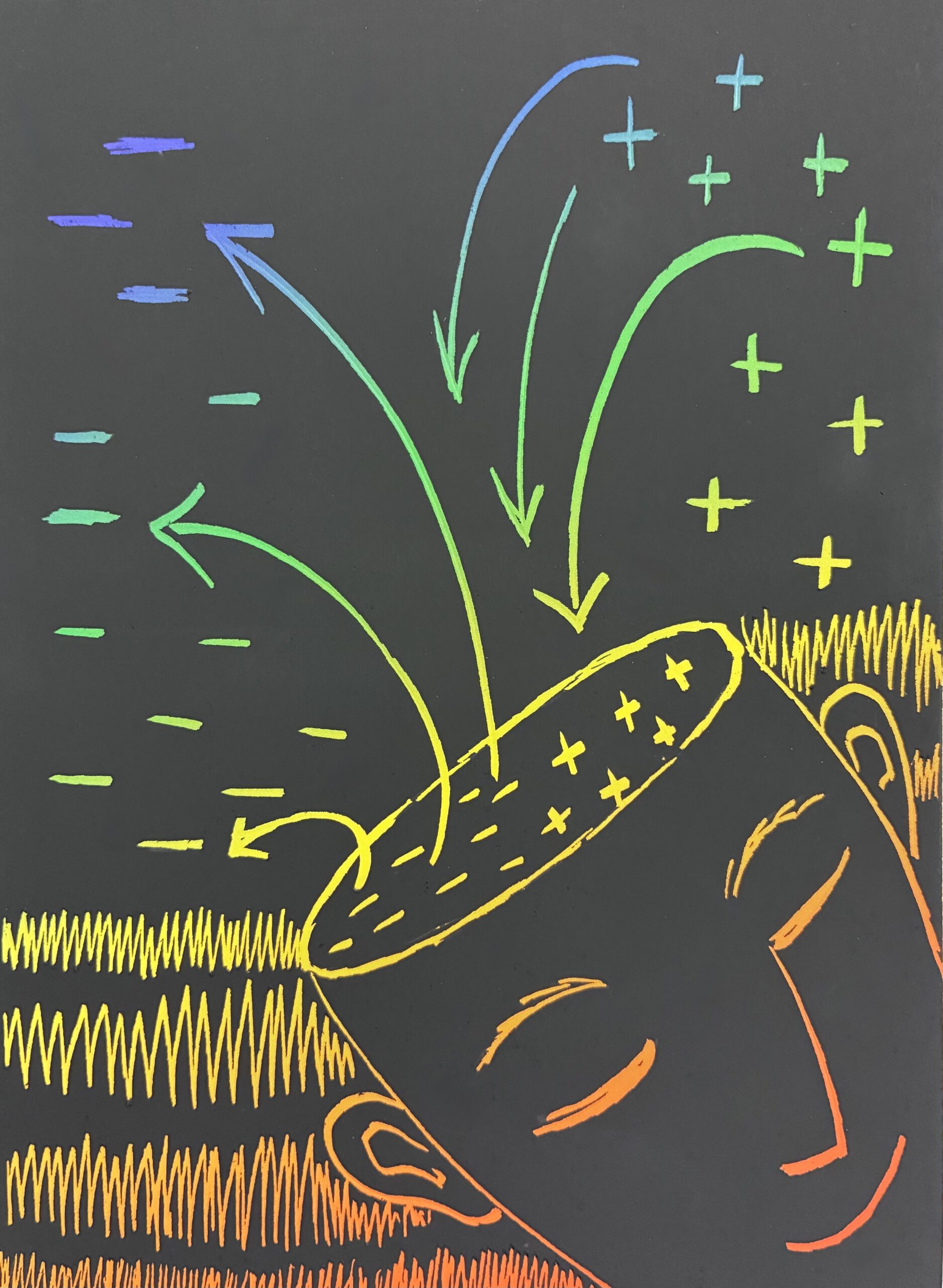
Out with the Negative, In with the Positive…
-Artwork © 2026 Jan Ketchel

The subconscious mind never sleeps. How could it, when it runs the physical body, and the energy body as well in its nightly journeys in infinity?

The conscious mind, by contrast, does nod off during sleep, and unless something wakes it into a lucid state while dreaming, it brings but vague downloads back to waking life upon awakening. Those downloads are known as dreams.

Actually, even in waking life the conscious mind can be said to be largely asleep. When driving a car, or performing a routine task, the conscious mind typically turns over the wheel to the subconscious mind that then steers the body and mind via the established programs stored within it, known as habits.

The conscious mind often takes flight into fantasy or thought until called back to task for necessary direction. When not mindfully present, the conscious mind is subject to an internal dialogue that is constantly defining and judging how it sees the world.

This judging activity actually creates the self and the world we live in through the consistency of its judgments and the personal identity it suggests to the subconscious mind.

Thus, for instance, the internal dialogue will deliver feedback every morning about the quality of one’s appearance during a quick or extended view from the mirror. It will remind us of unfavorable issues as it surveys its reflection, likely generating uncomfortable thoughts and feelings about ourselves.

Moving along, there are countless judgments about clothing, food decisions, and news and social media presentations that are categorized by such parameters as safety/threat, like/dislike, good/bad, positive/negative, approach/avoid, relax/get tense. This nonstop background judging function is active every waking moment of the day.

Once a judgment, good or bad, has been assigned by the conscious mind the subconscious mind faithfully codes it as a generalized guide that is then applied to ongoing daily encounters and reinforced by the conscious mind via passive acceptance of the judgments presented by the internal dialogue. The internal dialogue suggests what we think and feel about everything.

This dialogue establishes our true working definition of our identity. It’s how we know ourselves and are recognizable to others. The dialogue is incessantly active in the background of our minds, informing and reinforcing our sense of self. Unless the conscious mind brings its awareness to the directives of this dialogue and introduces a new perspective, this habitual mind runs nonstop, defining our lives.

Shamans covet a state they call inner silence, where the internal dialogue is abruptly halted, as an opportunity to collapse the world held in place by the internal dialogue. At such moments, one becomes privy to truths camouflaged by the internal dialogue, as it constantly generates ordinary reality.

Meditation practices that assign attention to a single focus, such as a word or the breath, accrue, over time, to moments of respite from the internal dialogue in the quiet of inner silence. However, experiences of inner silence and non-ordinary reality are not sustained indefinitely, as navigating our everyday world requires reentering a fixation upon the ordinary state of solid reality.

Quantum reality may be a truer picture of ultimate reality but the discreet physicality of Newtonian physics is crucial to functioning in everyday life. The internal dialogue quickly restores the familiar such-and-such of our consensus ordinary reality.

However, the silver lining of the internal dialogue is its magical ability to construct our world according to what we tell ourselves. It runs on autopilot but we can consciously take charge of the internal dialogue and what we tell ourselves. We can change the suggestions we deliver to the subconscious mind, from negative or habitual to positive and helpful, which are then manifested as the mental, emotional, physical and spiritual circumstances of our lives.

Yes, we can change our minds, even permanently. Mind is the spiritual substance that condenses into physical reality. A changed thought or suggestion rearranges the physical state of our being. This is our magical potential.

We can use our propensity for an internal dialogue to create a new experience of self and world. To achieve this, we must take conscious control of the internal dialogue, for good.

When we volitionally express gratitude, compassion, and loving intentions toward self and others in our internal dialogue, we become the positive being that radiates such qualities. This entails a persevering effort to bring alertness to our ever-active but half-asleep conscious mind, to be mindfully present and positive toward all things.

I am a loving, compassionate being, grateful for everyone, and in awe of everything,

Continue to be well,
Chuck

Chuck’s Place: To Be Special And Not Be Special

The power of the dual mind is unlimited…
-Artwork © 2026 Jan Ketchel

I once had a professor hand me back a paper and say, “Yeah, you can write, but don’t get a fat head.” He was a weathered Irish alcoholic, a seasoned veteran of many a late night lecture at the pub.

He would write two sentences on the board from the current New York Times, then spend the entire class breaking it down, demonstrating countless violations in grammar, printed in this ‘revered’ newspaper.

He taught me to stay humble and play by the rules. I’ve never written anything since where I haven’t had his critical eye challenging my every word.

Christianity holds humility as a foundational virtue. “Pride goeth before the fall,” counsels King Solomon in Proverbs.

Certainly, the guidance to avoid ego inflation is central to psychological health. Its danger, in Narcissistic Personality Disorder, couldn’t be more evident than on today’s world stage.

Its prominence in Schizophrenia is also evident, where ego is often swallowed by the grander personality of a Napoleon or a Joan of Arc.

The struggle in Bipolar Disorder is often to take the elixir that renders one to the ordinariness of everyday life, surrendering a dip into the mania of infinite possibility, or a retreat into the utter inertia of depression.

This well-armed war on specialness requires us to knock on wood, to not tempt fate after making a boast. So great is the penalty for assuming even a hint of divine identification.

In fact, this overarching law to refuse all specialness has insisted that humankind disown and project any hint of supernatural power onto an outside entity, be it God, Goddess, or the Universe, as it fully embraces its unworthiness.

As they pray at the Catholic Mass, just prior to receiving Holy Communion, with its human ingestion of the Divine: “Lord I am not worthy, speak but the word and my soul will be healed.”

This preponderance of caution around assuming human specialness is not simply a conspiratorial effort to control the masses and create dependency upon manipulative prophets. To enter into one’s true specialness one must first defeat any attachment to self-importance.

Ego must be honed to handle the enormity of self found in the breadth of the subconscious mind. For much of life ego enjoys the falsehood of its self-importance. Its true task is to grow up and assume responsibility for directing its own inner divinity, the subconscious mind, to exercise its power for the greater good.

Rationality, the greatest achievement of the conscious mind, must be freed from its know-it-all fixation of ego certitude, to its necessary role of producing appropriate suggestions for the subconscious mind’s creation.

In this role, ego surrenders its self-importance to authentically serve the greater Truth. The truth is that we are beings with a dual mind. The conscious mind is assigned the role of leadership; the subconscious mind is the creator.

The subconscious mind can “heal your body and mind of all disease,” states Joseph Murphy in his epic, The Power of Your Subconscious Mind. However, to tap into such power the ego must lose its obsession with its own specialness and fully embrace its actual superpower of suggestion, responsibly.

The ego must also exercise its powers of reflection to arrive at truth, then deliver its suggestions faithfully to the subconscious mind.

To believe in the power of the subconscious mind is to know its power through direct experience. The road to that knowing requires ego’s dedication to exercising this power of intent, without attachment to the outcome.

The power of the subconscious mind can be used for healing, manifesting, change, creativity, inspiration, intuition, telepathic communication, a whole host of positive intentions.

Simply, or not so simply, closing the door to distraction, and incessantly repeating one’s intent through suggestion, initiates the journey of cooperative wholeness between the dual mind in the service of the greater good. A more special relationship there could not be.

Continue to be well,
Chuck

Chuck’s Place: Children Of The Mind

Thoughts have power…
-Artwork © 2026 Jan Ketchel

The conscious mind is the father. Thoughts that the mind entertains are like sperm cells. The subconscious mind is the mother whose eggs become fertilized by these thoughts in the form of the suggestions she is attracted to, and, hence, opens to conceive.

This resulting pregnancy in the subconscious mind is the creative process of transforming thought into material reality. As matter is gathered and ordered according to the thought blueprint, an idea is born into a physical life. Thus a child of the mind is born.

This might involve the arrangement of events or encounters in the flow of everyday life that fulfill the requirements to materialize one’s intent. Here, you see the law of attraction operating upon physical reality to create, in the flesh, the original thought, belief, suggestion or intention of the conscious mind. This is a step-by-step process, often with many building blocks assembling over time.

Children of the mind can assume many forms. The child of a gratitude practice is the inner experience of a lightness of being and joy of being. As we express gratitude from the conscious mind, the subconscious mind receives this compassionate intent and instructs the body to release deeply calming hormones that bathe the body and mind in utter tranquility.

Should the conscious mind harbor negative thoughts, the subconscious mind will dutifully produce children of distress, as the physical body will be taxed with having to house the energy of negativity. This might result in an inner hormonally produced bad mood, low level depression, or a state of anxiety.

Sometimes people experience a pervasive state of anxiety seemingly not attached to thought. Often this is connected to trauma, where life was frozen in the thought of the constant need for defense, unable to resolve in the delivery of processing its experience.

This frozen state of vigilance becomes a forestalled birthing process, housed in the body, that awaits the conscious mind, in the form of a midwife, to be present to its experience and help deliver it to resolved new life.

Often, outside thoughts enter the conscious mind seeking to influence our beliefs and behaviors. These might result in illegitimate pregnancies, especially if we attach to these thoughts without soulful vetting.

Cautionary guidance here is to remain in a passive mode when excited by a passion-induced thought. This passive state is actually a receptive state where one allows oneself greater access to the broader picture, which might expose the one-sidedness of the outside influence.

Additionally, when we are in the receptive state, we are opened to the greater wisdom of our interconnected reality. Synchronicities come that punctuate and affirm thoughts that present.

In this process, ego, or conscious self, receives the guidance of higher wisdom, which points the way to appropriate action for the greater good of self. With this clarity, passivity gives way to activity, as vetted suggestion is presented to the subconscious mind.

All people are parents and children of their own minds. Claim ownership of these creative possibilities and lead life into greater fulfillment for self and all.

With conscious intention and subconscious joy,
Chuck

Chuck’s Place: Positive Saturation

Generate Positive Feelings…
-Artwork © 2026 Jan Ketchel

Upon her arrival at Auschwitz at 16 years of age, the late Edie Eger was forced to immediately dance for the notorious Josef Mengele, known as, the Angel of Death. She chose, as she writes about in her best seller, The Choice, to imagine herself waltzing on stage at the Budapest Opera House, in the arms of a boy she loved.

For her stunning performance Mengele let her live and gave her a loaf of bread. Like her future mentor and colleague, Victor Frankl (author of Man’s Search for Meaning), Edie chose to exercise the power of the imagination to manifest staying alive.

What we imagine, is the blueprint the subconscious mind uses to create the physical outcome of our lives. To not pay attention to what we imagine is to allow our lives to unfold without clear intention. To choose what to imagine is to assume conscious responsibility for the content of our imagination and hence, the direction and outcome of our lives.

When it comes to the state of our health, the quality of our thoughts, as played out in our imagination, is fundamental. We are daily flooded with messages of vulnerability to outside invasive bacteria and viruses. As well, we are saturated with influencers touting potential remedies and preventive measures.

The imagination is solicited to play out these scripts that irritate and activate the central nervous system (CNS) to manufacture neurotransmitters, as well as the endocrine system to produce hormones, to prepare our body and mind for simply a thought of invasion of no true substance.

The subconscious mind responds to the imagination the same way it responds to actual reality. What we imagine is reality to the subconscious mind, which in turn innervates the brain to respond accordingly.

Rather than fixate upon the alarming messages seeking to generate a false reality in the mind and body, we are free to choose to focus our attention upon thoughts that calm the imagination and, consequently, the CNS.

These thoughts generate the production of feel good hormones such as serotonin, dopamine and oxytocin. These promote deep states of relaxation, calm and peace. If, in fact, a genuine threat were to present itself, our resilience, accrued from such calm practice, provides confidence to meet the challenge, rather than being overwhelmed by a crisis.

The practice I suggest to achieve such calm is quite simple. The internal dialogue within the mind never sleeps, but you can override it by taking charge of the words you say to yourself. Saturate yourself with positive words. Simply say them all the time, with intention.

If negative thought intruders momentarily steal your attention, simply shift to the positive words as soon as you notice the disruption. Don’t waste a second more thinking the negative thought.

Here are some positive word suggestions: peace, love, freedom, happiness, joy, comfort, relaxed, beauty, calm, pleasure, warmth, refreshed, happy, treasure, rested… Truthfully, the list is endless.

Choose a word. Perhaps say it many times at a chosen rhythm. Make up poems, jingles, or songs to play with the words. Saturate your inner experience with the words and positive feeling states they generate.

Also, when you say one of these words, they often bring up associations to similar words or experiences to be lived and enjoyed in the imagination. Go there.

One of the practices I enjoy is Vim Hof’s retentive breath work. I utilize the word method, choosing the word that feels right in the moment. I have been able to vastly achieve calm states during lengthy breath retention through this approach. These calm states are retained long after the practice has ended.

Positive saturation promotes deep states of calm to be readily available at the mere stating of a word. Positive saturation does not eliminate real challenges that must be met, but it removes the bulk of negative states manufactured in error.

Positively saturate yourself to your heart, mind and breath’s content,
Chuck

Chuck’s Place: The Truth About Relaxation

Relaxed Reflection…
-Artwork © 2026 Jan Ketchel

The truth about relaxation is that there cannot be relaxation if we are not in the truth.

If we tell a white lie, even if exquisitely justified, we will experience an excitement to the nerves that innervate our eye muscles, which will in turn throw our eyes slightly out of focus.

In fact, if we mistakenly misstate our age, with no intent to deceive, our eyes will be thrown out of focus. If we then state, or even just think our true age, our eyes will be restored to normal immediately.

The subconscious mind is responsible for this glitch. It knows the truth and cannot help but register a reaction, however subtle, to untruth. This is not from the place of morality or judgment; it’s simply the subconscious mind’s unswerving loyalty to the truth.

The subconscious mind is wired to do the right thing. This is how it keeps our physical body alive. Nonetheless, it is a true servant to the suggestions it receives from the conscious mind. It exercises its creative power to manifest anything we want, even if what we want serves not the true needs of the self. It will fully manifest a life of error, if that is what we choose to explore.

However, every thought and every action have an effect, which is often called karma. If our thoughts and actions misalign with the truth, the body will register a reaction that indeed, keeps the score.

Our thoughts and actions are constantly straining our central nervous system, often resulting in various states of dis-ease. Often this can manifest as physical symptoms that are erroneously thought to be physical problems, when in fact they are actually but feedback mechanisms from the body that reflect the disordered effects of our current state of mind.

Relaxation requires a quiet mind, where thoughts do not impose themselves upon the body.

The eye, like all senses, is a passive sense. Light waves impress themselves upon the retina, reflecting what is in the world outside of the eye. It does not see from the inside but is only impressed upon, like a small reflecting pool. Seeing is a completely receptive, inert state.

If we squint and try to see, we completely contort the eye and interfere with its receptive ability. To see best, the eye must be left alone, completely relaxed, to receive its impressions. To trust the eye, is to completely relax one’s grip upon it.

Taste is another sense that requires complete passivity to deliver a true flavor. If the mind decides to think and talk when we eat, we hardly taste our food at all. We cannot make ourselves taste.

The sensory capacity of our taste buds passively receives impressions from the food. It requires of our mind to relax its thinking, and passively be present and attentive to these sensations, to know the fullness of the flavors of what we eat.

Even touch is a passive sense. Although a massage therapist might be quite active in giving a massage, they must really be quite passive in order to receive the true state of a client’s musculature, which allows them to truly connect and know how best to touch.

Relaxation requires trust in the body, and trust in the subconscious mind.

If we passively let go of trying to control the non-activity of our senses, they will operate most efficiently.

If we center our attention on our eating, refusing thinking and talking, we will have a pleasurable and fulfilling culinary experience. This includes not listening to podcasts when we eat!

When we touch another, if we take our mind off our thoughts, we can, in the experience of sympathy, register the truth of that other person’s state of being, and instinctively deliver the right touch. And yes, when we actively touch, we are taking action, but it is action informed by the truth passively received.

When we act in alignment with truth, we are, and deliver, calm.

A path to relaxation is to intend that the conscious mind stay in alignment with truth. That truth is best known through passive presence that follows the guidance it receives from its senses and the natural wisdom of the subconscious mind.

Beyond the senses is the wisdom that all guidance arrives when we are calmly, passively available to receive it. If the mind is actively fretting about what decision is right, it is too distracted to take in the myriads of signs from spirit, often arriving through the subconscious mind, that point to the right path, the path of true knowledge.

Ego, for all its valiant efforts to anxiously do the right thing, is at its most mature when it waits, gets calm, and truly listens and receives the truth, from which naturally flow its true marching orders.

Get calm and really listen, effortlessly,
Chuck