Tag Archives: shadow self

Chuck’s Place: Loosening The Divine Imagination from Its Divine Shadow

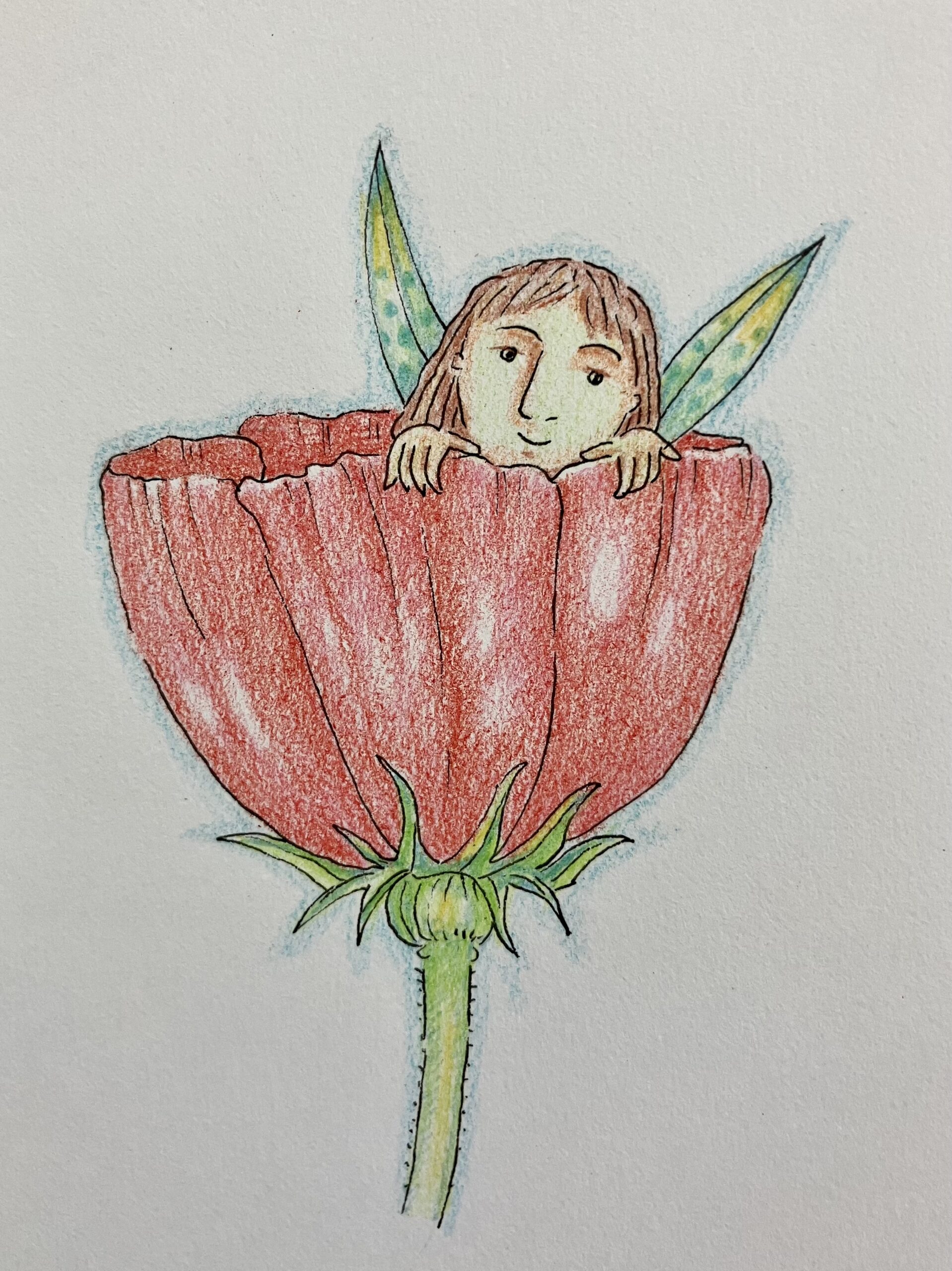
Know Thy Fullness of Self…
-Artwork © 2026 Jan Ketchel

Sigmund Freud and Carl Jung were the founders of a new psychology, one that grappled with an unconscious region of the psyche that cast a huge shadow over one’s fate and fulfillment in life.

Their healing technology was psychotherapy, an approach that brought to awareness those hidden influences from the depths, and enabled consciousness greater freedom in choosing the course of one’s life.

Freud’s contribution centered on one’s personal unconscious, repressed instincts and traumas that severely compromised normal adaptation to life. Jung, went far deeper into the shared collective unconscious of humankind, which contains all the experiences of human history that weigh heavily upon the present life of every individual.

Simultaneous with this fledgling new world of psychotherapy was the mystical world of hypnosis with its explorations of the fuller capacities of the subconscious mind, as well as The New Thought Movement that focused on the divine capabilities of the human mind.

Jung discusses his early meetings with William James, considered the father of American psychology, where he felt professionally encouraged to explore more deeply the mystical and spiritual depths of the psyche. However, Jung was reticent to alienate the new science of psychotherapy from mainstream science and he exposed little of his own personal transcendent experiences.

Consequently, both Jung and Freud remained steeped in bringing a rational perspective to the structure and dynamics of the shadow of the unconscious mind. Ironically, William James was far more open to validating spiritual approaches to the psyche, as well as being far more appreciative of the power of autosuggestion.

Today, mainstream science largely dismisses psychotherapy, which has been replaced by the deepening materialist emphasis upon brain functioning. New Thought is alive and well but has largely been dismissed as lay positive psychology.

The consequence of these dismissed and varied approaches to the mind has left humankind largely ignorant of both its shadow roots and its divine potential. Shadow is real, but so is divinity. Both the history of the human race and our personal history overshadow access to our human imagination, the divine center of our being.

When we are unconscious, and unreconciled with our shadow roots, it creates a veil over our divine imagination that confines it’s divine creative capability to repeating and generating the negative worldview of our suggestive inner dialogue. Our divine capacity to manifest remains fixed on generating powerlessness and victimhood.

Yes, our shadow is divine and must be lived, as ultimately, all that is, is one divine being. But the karma of shadow is to seek completion through spiritual liberation. One approach to shadow work remains with psychotherapy, as the shadow is identified and integrated through inner and outer work.

Neville Goddard, of New Thought tradition, recommended the art of revision to address the shadow. Here we are instructed to fully acknowledge the play of our shadow in our regretted behaviors in life. With total acceptance we then allow ourselves to fully inhabit, in the imagination, the state of being that fully lives out that which we would have wanted to do instead.

In order to fully imagine this correction, we have to fully feel it and live it in the imagination. When this is accomplished we indeed  change, or evolve, the past into complete resolution. With this we are freed to release the divine creative capacities of the mind to manifest the reality we truly want to live in. This is not rejecting or repressing shadow, it’s evolving it.

Go to that which you desire. Imagine it accomplished. Bring your physical senses into the realness of your imagination; see, hear, smell, touch and taste. Luxuriate in gratitude and awe.

If something from down below refuses to loosen its grip to your happiness then slide down and bring light and compassion to that shadow part. Insist that it bless you and let you carry on, free at last.

Imagination is the heart of the Law of Attraction. What we truly believe about ourselves, and what we truly believe is possible, is that which we will manifest in our lives.

Acknowledge the roots of your divine shadow. Then, imaginatively grow them into the flower at the heart of your deepest desire. Truly imagine it, and just let it become.

Becoming,
Chuck
Chuck’s Place: Taking The Pain Out Of Archetypal Bite

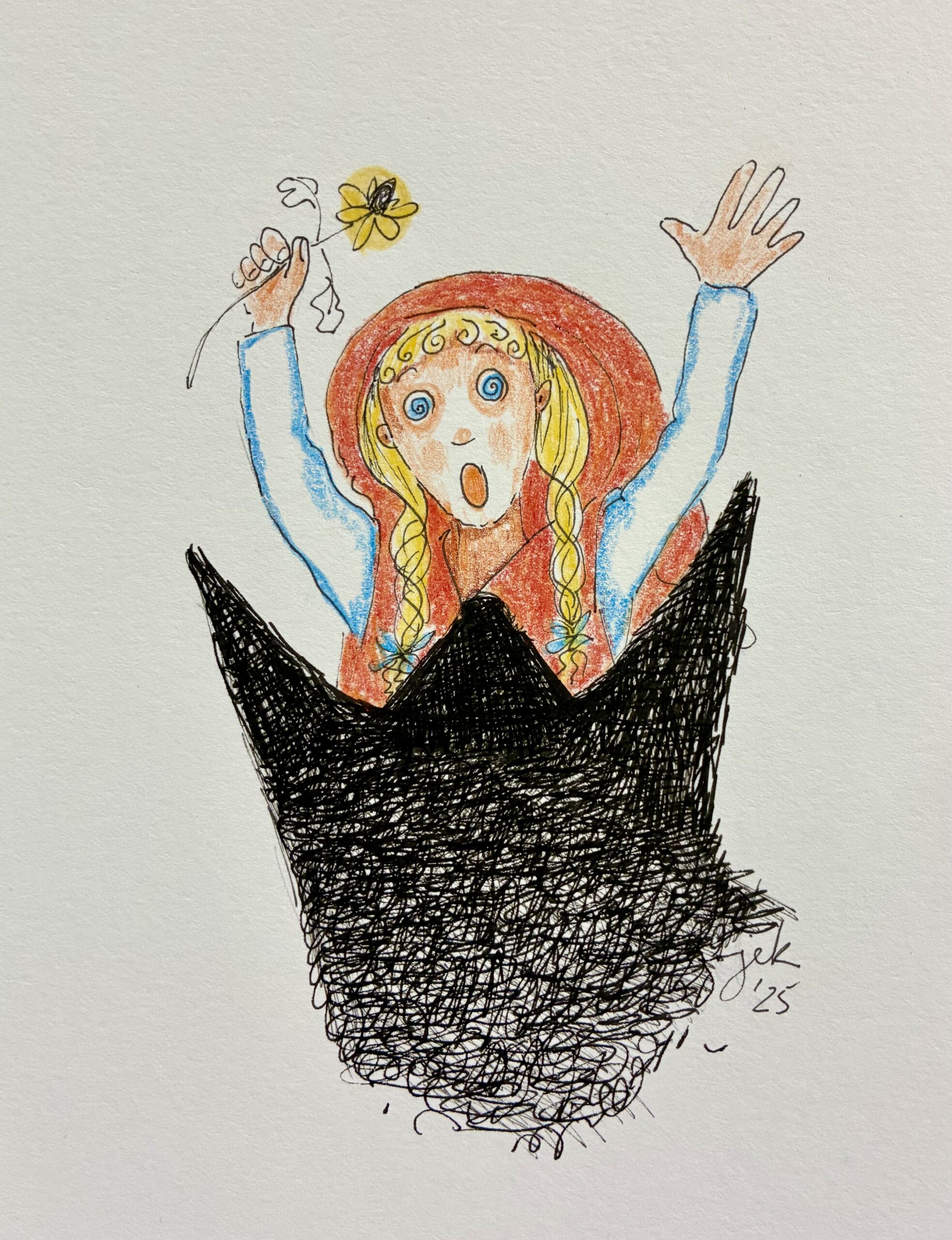
We are all frozen children when our triggers show up…
-Artwork © 2025 Jan Ketchel

When we get triggered we are involuntarily seized by the power of an archetype. Archetypes are the core building blocks of human experience that lie dormant in the ocean of our shared collective unconscious until called forth to define and respond to a situation we encounter. 

The terror of a trigger is a tidal wave of emotional archetypal energy that floods both body and mind with panic. “Who knows what evil lurks in the hearts of men? The Shadow knows!” is an apt definition of the Shadow archetype, as presented by the 1930’s radio mystery series. When we are caught off guard by an encounter, the Shadow archetype—the mystery and danger of the unknown—is activated, and we are in its grip.

Jung defined the shadow globally as everything that we are but don’t know about, which exists in the dark; hence, the term, shadow. Many things that exist in this dark region of the unconscious mind are purposely kept there because they evoke both fear and anxiety, which greatly compromise our stability and ability to function.

We are all frozen children in relation to our triggers. A child state is one of innocence. Shadow shatters innocence. We are no longer safe. We then install the protection of constrictive body armor. Our freedom of movement is checked by insistence of advance notice of everything.  Our breath is shallow and often held.  Our mind is either hypervigilant or not present at all.

The normal child state precedes the age of responsibility. The child, by definition, is taken care of. The overpowering danger of the greater world is held in abeyance until it is confronted by the shadow of the unexpected. When our adult state of confidence and autonomy is overpowered, we too become like children, overwhelmed by the unknown.

If we choose childlike defenses, we are caught in the existential kink of anguish, which contains the emotions of archetypes, generating the illusory belief that we are in control. Truthfully, however, we are like children playing hide and seek. We are victims, clinging to the child state of non-responsibility. We become like Little Red Riding Hood, haunted by the shadow of the Big Bad Wolf.

To defuse the power of archetype, we must first be willing to turn on the light in the shadow. This can be initiated by stating the intent to master the unknown trigger. Here, consciousness is taking a stand and presenting a suggestion to the subconscious mind. Previously, the subconscious mind was given the suggestion to avoid the trigger. That became its marching order and, consequently, an automatic habit.

This intent mobilizes the subconscious mind to channel the High Self, who then arranges a series of experiences tailored to achieve the necessary steps toward mastery. These experiences will show up in outer synchronicities, dreams and relationships. Slowly, the shadow archetype will be refined to reveal other archetypes that are the root causes behind the trigger.

For example, fear of approaching a woman might reveal the overwhelm of the Goddess archetype in all her piercing beauty; or terror of the Witch archetype, who threatens to castrate. Reflection on the terror experienced with an authority figure might reveal an encounter with a God archetype like Kronos, who would not even grant his children life.

The basics of achieving dominion over shadow require that we, as ego, undertake the Hero’s Journey. This will likely require that we revisit the triggers many times, as we gradually desensitize from them. When a trigger actually becomes boring, we are freed of emotional disruption. We are done.

There may be many other tasks to complete, as well, such as talking with or confronting someone, despite our trepidations. Inner mastery of the central nervous system through various kinds of breathing practices and body practices will support challenging tasks and build needed confidence.

Perseverance in all of these practices will eventually lead us to neutralize and integrate the shadow of all of our triggers. With this comes the restoration of a child’s innocence in the personality, coupled with an adult knowing that indeed, we can navigate the big bad world with truth and right action, the essence of love and wisdom.

Reflecting,
Chuck 

Soulbyte for Wednesday June 19, 2024

-Artwork © 2024 Jan Ketchel

In the play of light and dark, in the shadows of the self, find the inner you that calls out for acknowledgement and healing. You are all complicated beings with many sides, many issues and many agendas. Get to know all these sides, issues and agendas so that as they arise and ask for time and attention you are able to give them what they need. Acknowledge them, question them, listen to them, get to fully know them, accept and integrate them. In this manner, reconcile with them so that they do not rule you but still have their place, so that they do not blindside you over and over again but become so known that you see them coming from miles away. In knowing yourself fully and reconciling fully, life will begin to take on a calm, more focused agenda, with truth in the fore and illusion put to rest.

Sending you love,
The Soul Sisters, Jan & Jeanne

Chuck’s Place: Human Complexity

Working on unity…
– Photo by Jan Ketchel

Carl Jung defined a psychological complex as a ‘feeling toned idea’ that acts quite autonomously in the human psyche. When Jung was performing his word association tests he observed that certain words triggered delayed reaction times and emotional reactions in his experimental subjects. Something ‘else’ was interfering.

This led to his discovery that there are autonomously functioning parts of the psyche acting outside of consciousness. Jung called these influences ‘complexes’. Freud spent his entire career highlighting the Oedipal complex, which he considered the greatest unconscious influence upon the human psyche.

Today we have terms like alters, ego states, fragmented parts or archetypes to depict these autonomous influences upon consciousness. Robert Monroe took Western psychology a step further with his research into out-of-body (OBE) states, where consciousness discovers non-material parts of the self that regularly influence consciousness from subtler planes of existence.

Monroe’s discoveries concur with Hindu science with respect to the emotional/desire body as the first to be encountered in an OBE state. Many OBE explorers report an encounter with excess sexual desire in their early explorations. Monroe also discovered a preponderance of sexual preoccupation by many travelers who had left human form through physical death, as they remained fixated on sexual activity, though lacking a physical body.

Monroe’s discovery certainly lays credence to Freud’s emphasis upon the overarching significance of sexuality for human beings. Sex may be the major karmic issue that sends disembodied spirits back into human life. Monroe also reported encounters on the astral plane with the energy body of sleeping human beings, equally preoccupied with sex in their dream states.

Beyond sex are the many emotional attachments that humans, in their energy body OBE states, are found to be preoccupied with. Civilization, with its emphasis upon reason, uniformity and conformity, has suppressed and repressed the spontaneous living of impulse. What we previously considered as repressed and contained within the psyche in the physical body may be very actively living on the astral plane outside of human consciousness.

The current polarized attitudinal split in the human race might actually reflect this polarized split within the human psyche, manifesting as an outer collective opposition. If we distill this opposition, it could be reduced to, simply, reason vs impulse. Resolution of this opposition is fundamental to unified progress.

Shamans introduced the practice of recapitulation as one’s individual soul retrieval journey. If one can bring consciousness and reconciliation to all of one’s parts, one can achieve wholeness while in human form. To the extent that this remains incomplete will determine one’s karma. After all, how can one go forward as a fragmented soul. One must first discover and gather together all of one’s parts.

Elmer Green served as his wife Alyce’s shamanic guide in her journey through Alzheimer’s disease. Alyce had spent her entire adult life immersed in the highest of spiritual principles. As her energy body journeyed into the astral plane, as she went the course of Alzheimer’s, she encountered her shadow self, the repressed and unloved side of herself, for the first time.

Besides her memory loss, she became paranoid and rageful much of  the time. These experiences were largely driven by her encounters with her unknown self. With extreme patience, Elmer helped her to get grounded and reconcile with her fuller self. This enabled her to enter infinity at an advanced level, well beyond the shadow bardos, when she physically died in this world.

Jung’s choice of the word complex to denote autonomous parts of the psyche truly holds up. Humans are complex beings! The key challenge in human form is to resolve all of one’s complexes and become one’s true wholeness. With wholeness one’s energy is fully united, as everything becomes possible.

From complex to unity,

Chuck