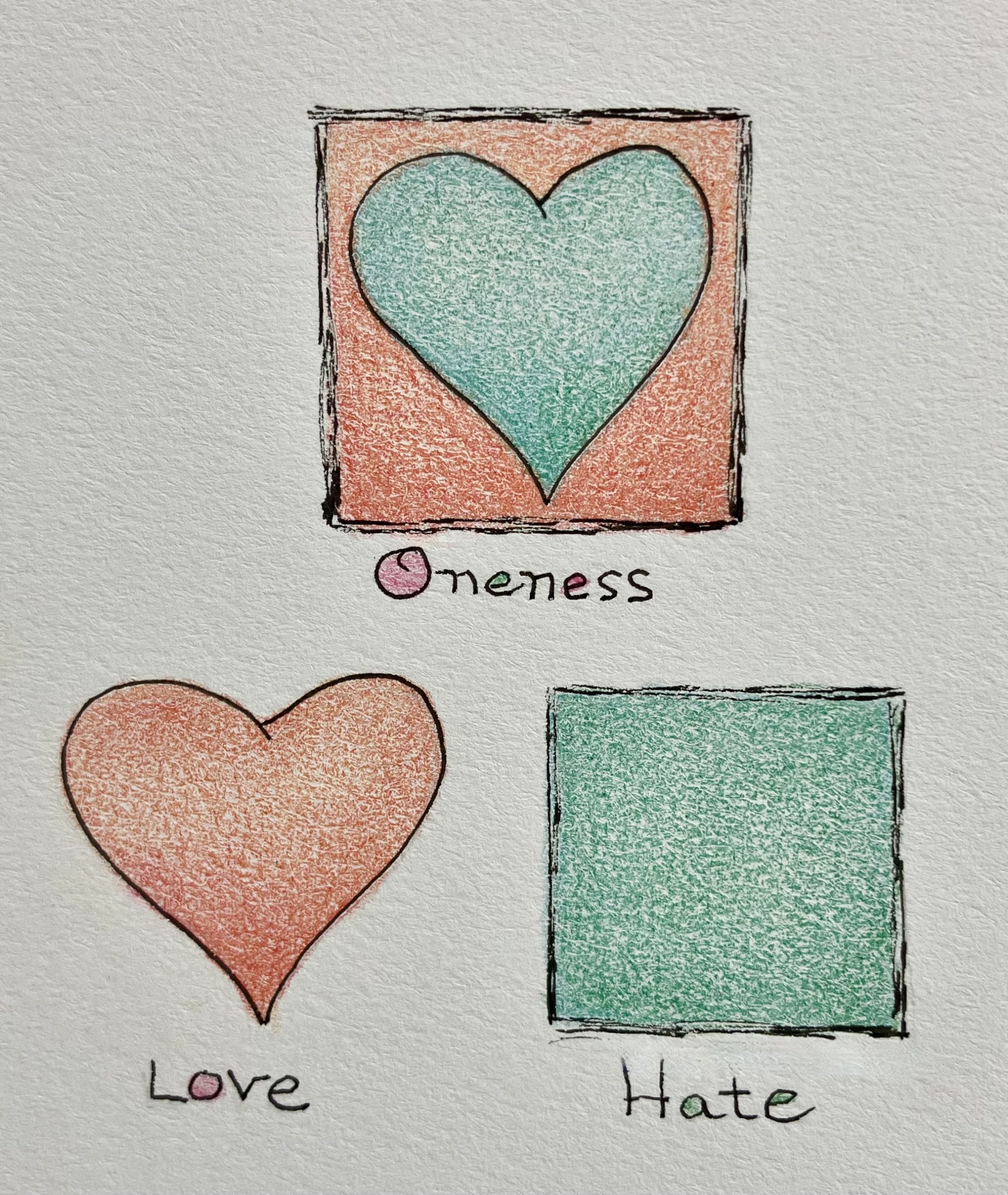
To train in the ways of the heart is a noble pursuit. Many people are seeking the heart-centered path, so remember that you are never alone in your search for balance, equanimity and a new way of proceeding along the path of life that is all-inclusive and all-loving. If ever there was a path of right action it is the heart-centered path of ego detachment and letting go to the greater truth of Oneness.
When things in the outside world turn chaotic, turn inward to your heart center and remind yourself of your infinite self, of your basic energy self, of your eternal being that knows all, sees all, and understands all. When you step back into this Higher Self, you give yourself the opportunity to reconnect with the larger picture of your own life but also with the larger picture of life on Earth. What is really going on when life on Earth gets chaotic? The answer to that question is simple: change. Change is being called for, outside and inside, which are really one and the same. You are a microcosm of the whole, the whole being the world around you, all the people and living creatures who inhabit the Earth with you, and the Earth itself and the greater cosmos as well. You cannot separate yourself from all that is, nor can you separate all that is from you. Keep this in mind as your day-to-day life unfolds and as you have things to deal with. What you are dealing with, the world is dealing with. And what the world is dealing with, you are dealing with. If you set your intentions to get right within yourself, you will also be setting the intention for the world to get right too. It’s that simple.
The term scapegoat had its literal origin in instructions outlined in the Old Testament for a practice on Yom Kippur, the Day of Atonement (Leviticus 16:8-10). An actual goat was chosen for practitioners to, literally, project their sins upon that would then carry those sins away from the community as it was sent off into the wilderness.
The relief afforded by this ancient ritual, of assigning the weight of one’s committed sins to another to carry, was defined in modern times by Sigmund Freud, as the ego’s defense of projection.
The action of this defense is the ego protecting itself from the negative judgment of its conscience (superego), for wrongful thoughts and actions, that would otherwise result in the consequences of shame and punishment. Thus, in scapegoating or projection, an innocent person is blamed for the very actions and thoughts one seeks to disown.
Both Freud and Jung emphasized that projection was not a conscious choice, it happened unconsciously and automatically. Jung went on to broaden the function of projection beyond a psychological defense only. He identified that the unconscious mind reveals its fuller self to the conscious mind by projecting its contents, or complexes, like through a movie projector, upon the outer screen of our daily lives, replete with all its characters and dramas.
Through its projections upon other people in daily life, that snare us in emotional reactions and entanglements, the unconscious mind communicates with us by drawing our attention to people who mirror our own hidden selves.
Our conscious ego is then offered the opportunity to individuate, that is, to welcome home its unknown and disowned parts. This requires extreme moral courage while we face and reconcile with our shadow, or unknown self.
A more advanced technology than scapegoating, to redeem our sinful selves, has been attributed to Moses in Leviticus (9:18), via the commandment, to “Love your neighbor as yourself.” This exact guidance was reaffirmed and highlighted centuries later by Jesus Christ, to “Love your neighbor as yourself”, as a core ethic of his teachings. (Matthew 22:36-40).
The wisdom of this biblical injunction, to love your neighbor as yourself, is in its practicality and scope of healing potential. This is a technology of true love.
In order to love our neighbor we must retrieve and love our disowned, or unknown selves, completely, particularly the parts of our projected shadow that we loathe and have scapegoated in our projections onto our neighbors. No scriptural exceptions are made to this commandment. All neighbors, and consequently all parts of the self, must be loved.
The refusal to love and assume responsibility for the true self, with all its flaws and prejudices, results in the living of a false self, which creates illusion and dysfunction, both within and without. As psychosomatic medicine reveals, very often our physical ailments reflect the soul mirroring to ego consciousness the error of its judgments.
A physical ailment may reflect the unconscious mind using the physical body as its projective screen. For instance, digestive problems might be the unconscious mind symbolically communicating to the ego the ego’s refusal to accept a truth, as mirrored in the physical body being unable to properly digest food. In this case, acquiescing to the truth at the mental level might resolve the physical symptoms. Love of truth promotes physical vitality.
The shamans of ancient Mexico discovered that the wear and tear of living our illusions causes our vital energy to be dispersed to the periphery of our physical beings, compromising the efficiency of our vital energy centers, or what the Hindus call chakras.
Some of these illusions are traumas, stored in the body, whose life experiences have yet to be individuated into our wholeness. To access the abundance of our fullest potential, we must fully accept and love every aspect of our selves, including our entire lived life experiences.
If we scapegoat any life experience, or anyone in that life experience, we are a fragmented, divided wholeness. We must love it all, unconditionally, no exceptions.
Gay Hendricks, in his classic book, Learning To Love Yourself, taught the practice of declaring love for every challenging or disagreeable part of the self, as it emerges. For example: “I love the part of me that feels hate. I love the part of me that objects to me admitting it feels hate. I love the part of me that hates that I hate. I love the part that judges me harshly…” With love comes acceptance. With acceptance comes abundance.
Out of sheer love, Carlos Castaneda gifted the world the fruits of his shamanic lineage before he closed the door and ended that lineage. One of those gifts was the magical pass of recapitulation, where one fully restores one’s energetic wholeness through reliving, and ultimately fully loving, every aspect of oneself and one’s life. This is being in the abundance of total love.
Love is the energetic vibration that opens us to the experience of our oneness with everything, the ultimate abundance. From this place of wholeness we are best positioned to suggest to our subconscious mind to manifest outwardly our heart’s desire. As within, so without.
Place yourself at the center of an imaginary circle. How big is your circle? It doesn’t matter. From the center point you have access to everything within your circle; everything belongs to you. Imagine what you want inside the circle with you. What do you need and most want? You are in control. What you bring in affects you. What you leave out affects you. Imagine this circle as a bubble surrounding and protecting you. From it you can reach out or remain inside; it’s up to you. The illusion is that you are alone, but you are not. You are one circle among many, all living together, safe and protected alone and safe and protected as a mass; like a school of fish. You are part of a greater universe, and just as your little bubble is your responsibility so is the greater universe. You are inherently affected by everything and everything affects you. Such is life.
Don Juan Matus explained to Carlos Castaneda that, yes, our world is a world of separate objects. However, beneath that world of separateness, we are all in a state of one interconnected energy. In that state of oneness, love is the energy of cohesion, that which holds together and welcomes all of its neighbors.
Don Juan also explained that we live in a predatory universe. Indeed, all life feeds upon life, and yet, at a soul level, energetic life is never lost, it merely changes form.
Survival, in our separate human form state, requires an instant ability to judge safety and danger. That which we judge to be dangerous we come to hate. Hate is the emotion that allows us to dehumanize and destroy that which we judge to be different and threatening to our survival.
Oneness and separateness are a pair of opposites that constitute a core challenge to life in human form. It all begins with the symbiotic oneness of mother and embryonic fetus, in pregnancy, that ends in the separation of the one into two distinct beings at birth. The challenge to become a fully realized separate being, who can open to the oneness of love, is the art of human life.
We are drawn to relationship in a quest to reunite with our lost oneness. Union is driven by the natural attraction of opposites for each other. This is love in energetic motion. When these opposites unite there is frequently a honeymoon phase, where opposites relish the relief and ecstasy of restored oneness.
However, as relationships progress, one’s separate, differentiated self reemerges and finds itself in opposition with its soulmate. This reemergence frequently leads to competition and opposition of viewpoints in the relationship. The couple is then challenged to make room for their differences in the wholeness of their relationship. Far too often, bearing the tension of these unreconciled opposites results in the solution to hate one’s partner and end the relationship.
The solution of hate, devaluation, and demonization of the other is the frequent outcome of attempting to bear the extraordinary tension of differences necessary to reach a reconciling of opposites. This is evident in the wars that plague our world. The underlying energetic imperative to embrace all parts and peoples of the world in the oneness that we truly are is the evolutionary and karmic challenge of our time.
Beneath the opposites of love and hate is the oneness and separation phases of human and cosmic evolution. The separatist, hateful stage of human interaction must ultimately acquiesce to the greater harmony and love of energetic reality, which, like day turning into night, will naturally reassert itself.
As we live through this stage of human evolution, which emphasizes separateness and hate in human relations, may we bear its tension and find the path that will lead us to our underlying wholeness, with renewed balance. This is the path where love and hate meet in a union that makes room for all.