When things in the outside world turn chaotic, turn inward to your heart center and remind yourself of your infinite self, of your basic energy self, of your eternal being that knows all, sees all, and understands all. When you step back into this Higher Self, you give yourself the opportunity to reconnect with the larger picture of your own life but also with the larger picture of life on Earth. What is really going on when life on Earth gets chaotic? The answer to that question is simple: change. Change is being called for, outside and inside, which are really one and the same. You are a microcosm of the whole, the whole being the world around you, all the people and living creatures who inhabit the Earth with you, and the Earth itself and the greater cosmos as well. You cannot separate yourself from all that is, nor can you separate all that is from you. Keep this in mind as your day-to-day life unfolds and as you have things to deal with. What you are dealing with, the world is dealing with. And what the world is dealing with, you are dealing with. If you set your intentions to get right within yourself, you will also be setting the intention for the world to get right too. It’s that simple.
The term scapegoat had its literal origin in instructions outlined in the Old Testament for a practice on Yom Kippur, the Day of Atonement (Leviticus 16:8-10). An actual goat was chosen for practitioners to, literally, project their sins upon that would then carry those sins away from the community as it was sent off into the wilderness.
The relief afforded by this ancient ritual, of assigning the weight of one’s committed sins to another to carry, was defined in modern times by Sigmund Freud, as the ego’s defense of projection.
The action of this defense is the ego protecting itself from the negative judgment of its conscience (superego), for wrongful thoughts and actions, that would otherwise result in the consequences of shame and punishment. Thus, in scapegoating or projection, an innocent person is blamed for the very actions and thoughts one seeks to disown.
Both Freud and Jung emphasized that projection was not a conscious choice, it happened unconsciously and automatically. Jung went on to broaden the function of projection beyond a psychological defense only. He identified that the unconscious mind reveals its fuller self to the conscious mind by projecting its contents, or complexes, like through a movie projector, upon the outer screen of our daily lives, replete with all its characters and dramas.
Through its projections upon other people in daily life, that snare us in emotional reactions and entanglements, the unconscious mind communicates with us by drawing our attention to people who mirror our own hidden selves.
Our conscious ego is then offered the opportunity to individuate, that is, to welcome home its unknown and disowned parts. This requires extreme moral courage while we face and reconcile with our shadow, or unknown self.
A more advanced technology than scapegoating, to redeem our sinful selves, has been attributed to Moses in Leviticus (9:18), via the commandment, to “Love your neighbor as yourself.” This exact guidance was reaffirmed and highlighted centuries later by Jesus Christ, to “Love your neighbor as yourself”, as a core ethic of his teachings. (Matthew 22:36-40).
The wisdom of this biblical injunction, to love your neighbor as yourself, is in its practicality and scope of healing potential. This is a technology of true love.
In order to love our neighbor we must retrieve and love our disowned, or unknown selves, completely, particularly the parts of our projected shadow that we loathe and have scapegoated in our projections onto our neighbors. No scriptural exceptions are made to this commandment. All neighbors, and consequently all parts of the self, must be loved.
The refusal to love and assume responsibility for the true self, with all its flaws and prejudices, results in the living of a false self, which creates illusion and dysfunction, both within and without. As psychosomatic medicine reveals, very often our physical ailments reflect the soul mirroring to ego consciousness the error of its judgments.
A physical ailment may reflect the unconscious mind using the physical body as its projective screen. For instance, digestive problems might be the unconscious mind symbolically communicating to the ego the ego’s refusal to accept a truth, as mirrored in the physical body being unable to properly digest food. In this case, acquiescing to the truth at the mental level might resolve the physical symptoms. Love of truth promotes physical vitality.
The shamans of ancient Mexico discovered that the wear and tear of living our illusions causes our vital energy to be dispersed to the periphery of our physical beings, compromising the efficiency of our vital energy centers, or what the Hindus call chakras.
Some of these illusions are traumas, stored in the body, whose life experiences have yet to be individuated into our wholeness. To access the abundance of our fullest potential, we must fully accept and love every aspect of our selves, including our entire lived life experiences.
If we scapegoat any life experience, or anyone in that life experience, we are a fragmented, divided wholeness. We must love it all, unconditionally, no exceptions.
Gay Hendricks, in his classic book, Learning To Love Yourself, taught the practice of declaring love for every challenging or disagreeable part of the self, as it emerges. For example: “I love the part of me that feels hate. I love the part of me that objects to me admitting it feels hate. I love the part of me that hates that I hate. I love the part that judges me harshly…” With love comes acceptance. With acceptance comes abundance.
Out of sheer love, Carlos Castaneda gifted the world the fruits of his shamanic lineage before he closed the door and ended that lineage. One of those gifts was the magical pass of recapitulation, where one fully restores one’s energetic wholeness through reliving, and ultimately fully loving, every aspect of oneself and one’s life. This is being in the abundance of total love.
Love is the energetic vibration that opens us to the experience of our oneness with everything, the ultimate abundance. From this place of wholeness we are best positioned to suggest to our subconscious mind to manifest outwardly our heart’s desire. As within, so without.
Place yourself at the center of an imaginary circle. How big is your circle? It doesn’t matter. From the center point you have access to everything within your circle; everything belongs to you. Imagine what you want inside the circle with you. What do you need and most want? You are in control. What you bring in affects you. What you leave out affects you. Imagine this circle as a bubble surrounding and protecting you. From it you can reach out or remain inside; it’s up to you. The illusion is that you are alone, but you are not. You are one circle among many, all living together, safe and protected alone and safe and protected as a mass; like a school of fish. You are part of a greater universe, and just as your little bubble is your responsibility so is the greater universe. You are inherently affected by everything and everything affects you. Such is life.
Don Juan Matus explained to Carlos Castaneda that, yes, our world is a world of separate objects. However, beneath that world of separateness, we are all in a state of one interconnected energy. In that state of oneness, love is the energy of cohesion, that which holds together and welcomes all of its neighbors.
Don Juan also explained that we live in a predatory universe. Indeed, all life feeds upon life, and yet, at a soul level, energetic life is never lost, it merely changes form.
Survival, in our separate human form state, requires an instant ability to judge safety and danger. That which we judge to be dangerous we come to hate. Hate is the emotion that allows us to dehumanize and destroy that which we judge to be different and threatening to our survival.
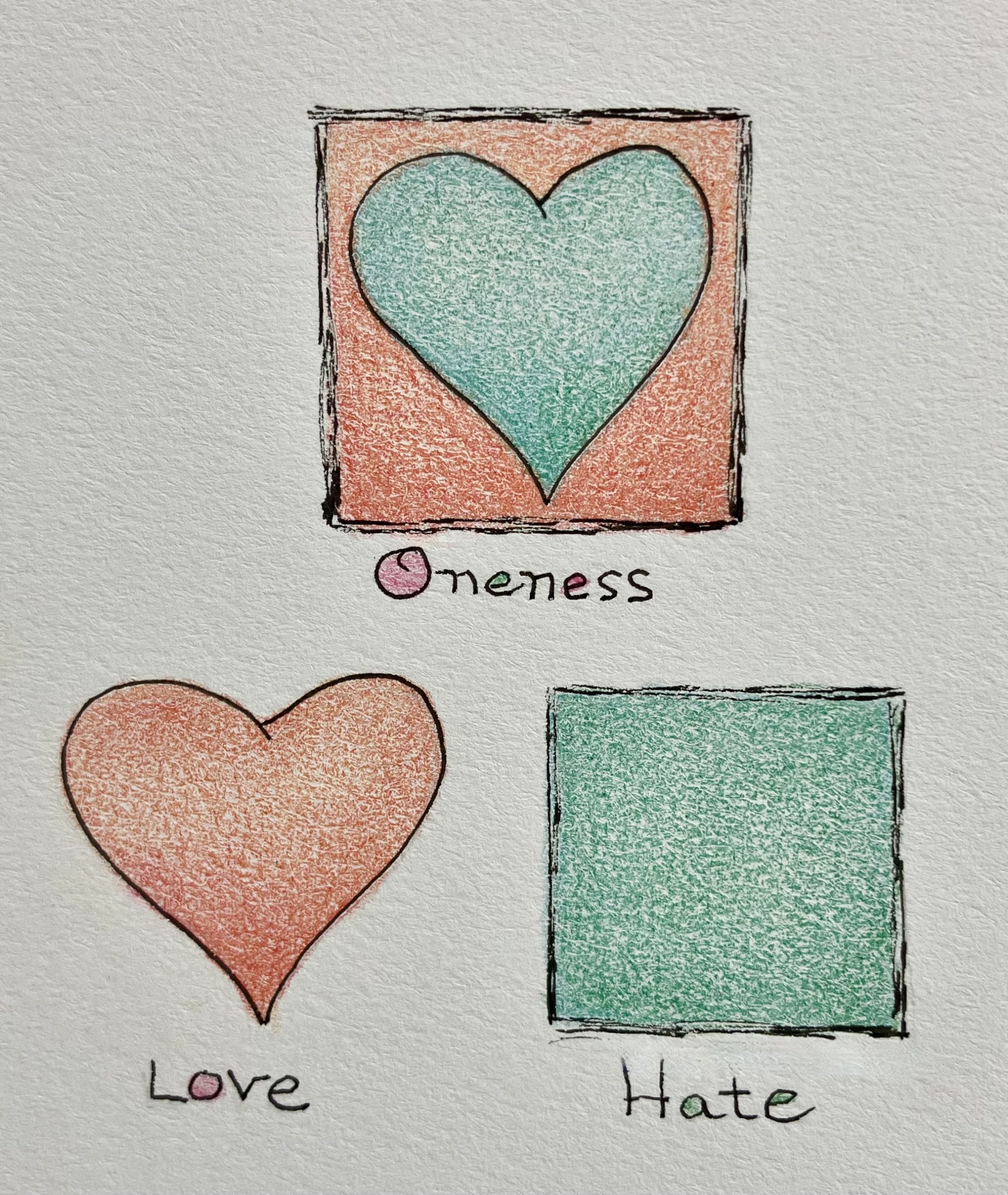
Oneness and separateness are a pair of opposites that constitute a core challenge to life in human form. It all begins with the symbiotic oneness of mother and embryonic fetus, in pregnancy, that ends in the separation of the one into two distinct beings at birth. The challenge to become a fully realized separate being, who can open to the oneness of love, is the art of human life.
We are drawn to relationship in a quest to reunite with our lost oneness. Union is driven by the natural attraction of opposites for each other. This is love in energetic motion. When these opposites unite there is frequently a honeymoon phase, where opposites relish the relief and ecstasy of restored oneness.
However, as relationships progress, one’s separate, differentiated self reemerges and finds itself in opposition with its soulmate. This reemergence frequently leads to competition and opposition of viewpoints in the relationship. The couple is then challenged to make room for their differences in the wholeness of their relationship. Far too often, bearing the tension of these unreconciled opposites results in the solution to hate one’s partner and end the relationship.
The solution of hate, devaluation, and demonization of the other is the frequent outcome of attempting to bear the extraordinary tension of differences necessary to reach a reconciling of opposites. This is evident in the wars that plague our world. The underlying energetic imperative to embrace all parts and peoples of the world in the oneness that we truly are is the evolutionary and karmic challenge of our time.
Beneath the opposites of love and hate is the oneness and separation phases of human and cosmic evolution. The separatist, hateful stage of human interaction must ultimately acquiesce to the greater harmony and love of energetic reality, which, like day turning into night, will naturally reassert itself.
As we live through this stage of human evolution, which emphasizes separateness and hate in human relations, may we bear its tension and find the path that will lead us to our underlying wholeness, with renewed balance. This is the path where love and hate meet in a union that makes room for all.
We are all ultimately One, but the structure of this world that we live in is one of separate objects, with distinct differences.
Christian Science suggests we link our consciousness with our core identity, that perfect Oneness, whereby healing the illusion of disease in a non-existent, separate physical body.
Hindu philosophy calls this illusion of separateness maya. Maya spins and directs lila, the creative divine play that results in the current world drama that we personally experience as the fixed reality of our world. To become enlightened, one must fully engage in the current play yet be aware of the limitations of its illusory solidity, and the fact of its impermanence. That’s what is meant by non-attachment.
The shamans of ancient Mexico call assuming this role of non-attachment stalking. In stalking, we fully embody the character we intend to become, sometimes even temporarily forgetting our true essence as energetic beings when we do so. From a shamanic perspective, our world is generated by fixating our consciousness upon a program that assembles our awareness to perceive a world of distinct solid objects.
Carlos Castaneda pointed out that it is sheer magic to be able to conjure this solid world. He called human beings magical beings because of their ability to so fixate their awareness as to generate such a magical event. However, he truly lamented how this single assemblage point of awareness had become the sole fixation of human consciousness. We have forgotten that we are indeed magical beings capable of unlimited possibilities.
In my time in Carlos Castaneda’s world, I once observed him personally demonstrate a physical movement to break this fixation of limited awareness. He was a short man. He turned his back to us, performing a kind of shoulder roll.
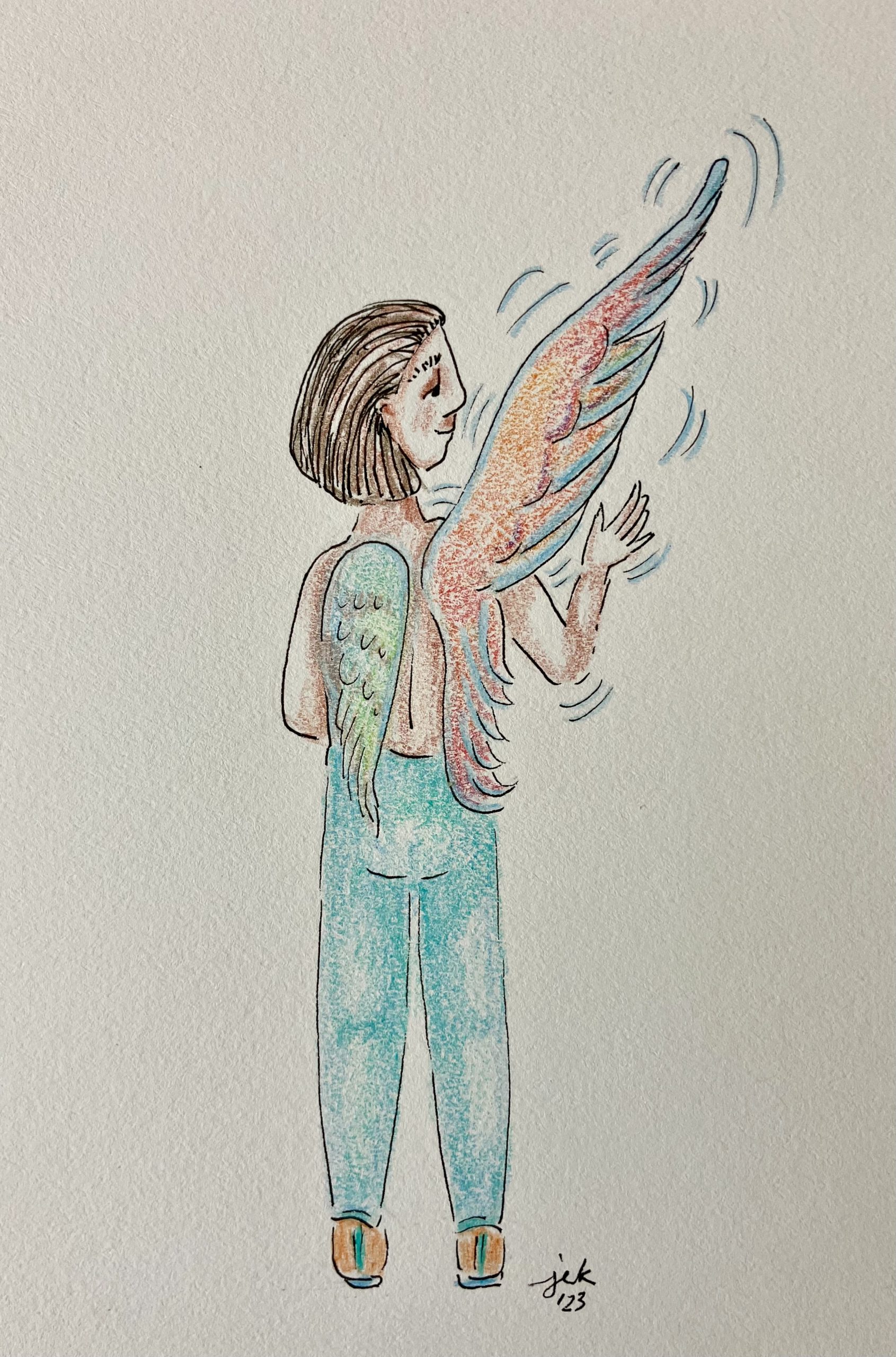
He keenly stated that we are magical beings whose wings have been clipped. With that he urged us to literally free our wings, demonstrating with a movement initiated from the wing itself; engaging the fullness of the entire back rather than a shallow roll of the shoulder. I saw the profound movement of the depth of his wing.
It’s a simple movement. Imagine the wing. Feel an impulse to move it. Be led by it.
The maya of the human mind is one of duality. We appear to have two distinct minds. That is the divine lila of life as it is played out in the current fixation of the human form. These two minds are the ego and the subconscious. The dance between these two minds is our true inner soulmate relationship in this life, replete with all the agonies and ecstasies of human relationship.
The ego is our objective, reasoning mind. The ego is the seat of consciousness. The ego greatly identifies with life in its physical body. The ego is the home of personal identity; the ego says, “I am.” The ego exercises the directive power of free will, choice, and decision making. The ego is charged with the responsibility of leadership in its human life.
The subconscious is the home of total memory. Every moment of our life is recorded there. While the ego may retain some memory, the subconscious records it all. During recapitulation we experience the relationship of ego and subconscious, as the consciousness of now is reconciled with the full experience of the past.
The subconscious operates through intuition. The subconscious is the remote viewer that can travel way beyond the confines of the physical body and observe events on the other side of the world, or in the cosmos. The subconscious has access to the Akashic records, the collective unconscious history and accrued knowledge of our species.
The subconscious is the seat of telepathy; it receives and can read the thoughts of others. The subconscious runs all the operations of the physical body. The subconscious houses the instincts and is the home of emotions.
The subconscious is our magical mind. It does not reason; its modus operandi is suggestion. Whatever suggestion it receives, it will fully bring to life. With its vast tools and resources, the subconscious can manifest, to the best of its ability, any suggestion it decides to adopt.
Unknown to us, the ego and the subconscious constantly work in tandem. Thoughts from the ego become directive suggestions to the subconscious, which then turn into a set of habits that automatically control our lives.
The subconscious is also quite receptive to the suggestions of others. We may notice our attitudes, moods and behaviors greatly impacted by our interactions with others. This may largely be the suggestive influence of someone else’s energy upon our subconscious. As opposed to the ego, with its fixed identity, the subconscious does not have a personality. It is an open book that willingly embodies the content of suggestions, wherever they may originate from.
Healthy leadership by the ego, in the quality of its suggestions to the subconscious, creates the ideal relationship between the two minds. This requires the ego to firstly be in alignment with its Spirit as the arbiter of right action. The ego must also accept the existence of the subconscious mind with all its magical capacities. This is often a tall order for the ego to undertake, which clings to its rationality as ruler and dismisses the greater powers of the subconscious mind.
The ego needn’t believe in the power of the subconscious to access it. Merely rotely repeating a suggestion, ad nauseam, is bound to register eventually as a directive to the subconscious. If I notice a headache brewing, I direct my subconscious with the incessant suggestion that the headache is healing, and is healed. If it disappears, as it often does, I acknowledge the fact of the power of the subconscious to heal.
The ego comes into better relationship with the subconscious when it can expand its rationality to include the fact that the subconscious has abilities that appear to defy logic. Exercising the intentional practice of autosuggestion can produce results that broaden the ego’s reason to include the magical potential of the subconscious mind. Rather than dismiss miracle cures as placebo, scientists would do well to study the factual abilities of the subconscious mind to alter physical events in the body through the power of suggestion.
Reconciliation of mind is ego valuing the subconscious, and consciously feeding it suggestions for the greater good of self, other, and world.
When we leave this life in our soul body, our mental body, of ego and subconscious, will leave as one. As we journey beyond the physical body this reconciled mind is our navigator in the great beyond. Use this life now to bring mind into a partnership to truly serve your evolving soul.
Now and then,* Chuck
*I am blown away by the magic of the release of the modernly engineered Now and Then, the Beatle’s final song, which is #1 on the musical charts. The generation of now is claiming their own rightful ownership of the Beatle’s Aquarian magic, as well as John Lennon’s soulful reconciliation of relationship. May its energy further permeate the world and its reconciliation of relationship.