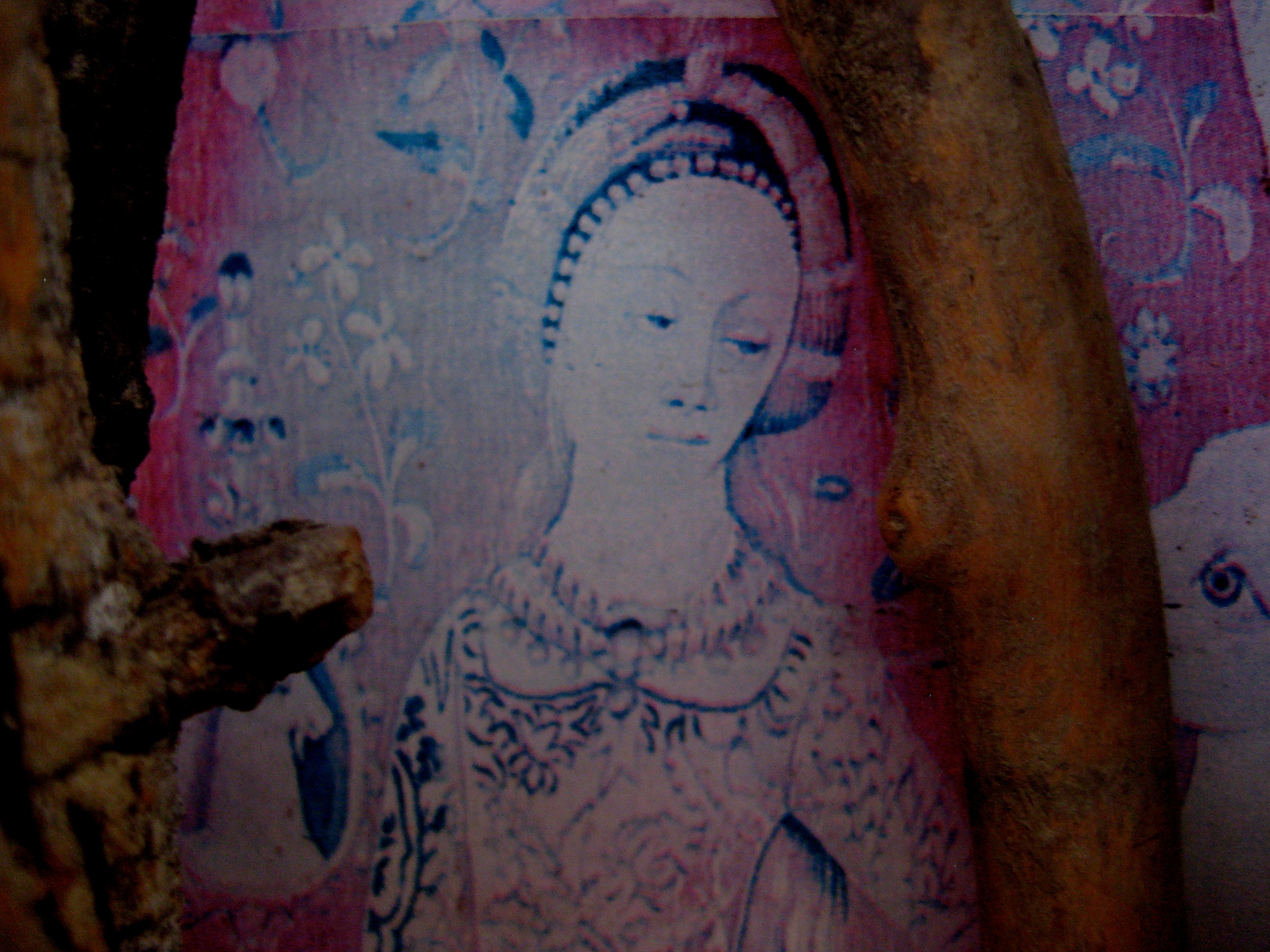
– Detail from a collage by Jan Ketchel
Here is the channeled message for the week. Jeanne offers us a simple practice to enhance awareness of and connection with our higher self.


The ego is quick to categorize the terrifying experience of a nightmare as a bad dream, best to be forgotten. The ego would be wise, however, to suspend that automatic protective judgment and ask the question: What was the function or purpose of the disturbing dream?
Behind the dream and the dreamer—our consciousness in dreams—lies the dream maker. The dream maker is the Self, the higher self that has made all the major survival decisions through the course of our life.
It is the Self in our tender years of youth who brings us fairytales to secretly live by as we encounter the harshness and brutality of actual reality that fails to safely usher us into secure psychological life. This compensatory secret life is the very one needed to nurture and tend to our fledgling ego’s fragile hold on life.
It is the Self as well that decides to fragment our overwhelming experiences in that harsh reality, burying for safekeeping our true spirit until a more opportune time to be born arises. This same Self chooses where we will be taken, what we will be shown and, most importantly, what we will emotionally experience in our nightly dreams, the intent being to better position our waking consciousness to take forward the quest for wholeness and individuation.
An encounter with a terrifying character in a dream might signal the Self’s urging to take up the task of integrating a traumatic experience, perhaps something long held in storage that left a delicate, vulnerable part of the spirit encrusted for decades. The Self might be suggesting to the ego self that the time is ripe to pick up a sword and not only face this ancient encounter, but cut through the encrustment to free this vital part of the self.
A series of frustrating, anxiety-producing mundane dreams might set the waking mood of frustration as the Self seeks to energize the waking self to break through its repetitive fixation on a habit that dominates life but imprisons the developmental needs of the self.
A sleepless night might be the Self’s decision to weaken the ego’s daytime hegemony over life so that it might raise to consciousness disturbing truths normally held in check. This may be the very thing needed to compel the ego to pay attention to its inner reality versus its usual focus on the events of the outer world and its position in it.

There may be many varied developmental motives in the Self’s spinning of its nightly dream encounters. If the waking ego dismisses these experiences upon awakening, it not only misses the gift and deeper meaning of the Self’s intent, but it further alienates itself from the Self’s goal of individuation, likely triggering even more severe attempts by the Self to get the ego on board. This can take the form of repetitive and deepening nightmares or the breakthrough of the dream projectively into daytime life, in the form of phobias or even hallucinations.
We do well to value and appreciate the Self’s intent to lead us deeper into our wholeness, valuing all of our dreams—fairytales and nightmares alike—diligently seeking out their deeper purpose. With that fearless approach we become allies with the Self as it leads us ever deeper on our journey to wholeness.
Appreciating the dream,
Chuck

We issue forth from infinity, a seed planted with the intent to individuate, to become a unique life with a specific purpose in this world. All seeds share the same fate: to become fully what they are. And when this life ends, we return from whence we came: “Going home behind the curtain, going home without the costume that I wore,” -Sincerely, L. Cohen—from Going Home
All the while we are here, we seek our lost wholeness in the many masks of God we attach to, projections that reflect our infinite Selves. But, while here, we are also on a mission. Our infinite self, Brahman, must stay safely ensconced behind our bliss sheath, beyond our awareness, as we, in turn, seek our bliss in becoming the seed we are intended to be in this life.
Joseph Campbell, like Carlos Castaneda, encouraged us to fully embrace and experience the life we are in. After all, our challenges are experiments from the fourth-dimensional Self, as Jung put it. For Jung, the fourth dimension was the dimension of quantum physics, which grasps the unitary interdependent nature of reality. It’s the dimension beyond space and time, where psyche and soma merge like a particle and a wave, in infinite oneness.
Jung designated our Brahman self, the Self, granting recognition to the part of us that is infinite, that lies behind the curtain. Less than one year before his death in 1961, Jung confided the following in a private letter:
“…one can define a dream as an experiment of a four-dimensional nature. I have never tried even to describe this aspect of dreams, …because I have found that our public today is incapable of understanding. I considered it therefore my first duty to talk and write of things that might be understandable and thus would prepare the ground upon which one could later on explain the more complicated things…” –C. G. Jung Letters, Vol. 2

Here, Jung hints that dreams, in sleeping and waking life, are experiments from the fourth-dimensional Self. The experimenter is the Self that lives in infinity. It is that Self that projects its seed of intent into this life. This higher Self intends the life we are sent to live in this third dimension of time and space, birth and death. Jung suggests that it is this higher Self—seeking to view, enhance, and experience itself in an experimental life—that projects us into this life, to then live that intent, whichever way it goes, bringing back its recapitulated experience to infinity in dying.
The Shamans of Ancient Mexico came to the same conclusion: we are beings projected from infinity, granted awareness that may be enhanced through experience—whatever that might be—in a three dimensional life, which eventually ends and contributes its findings back to infinity.
From this perspective, we can see that we are always in two places at once: Self and ego self, eternal and transitory. Furthermore, the antagonists in our life, our petty tyrants, are necessary players in our quest to individuate. Our petty tyrants rattle our self-importance. In fact, by their merciless actions, they stamp out any flame of ego-worth. It can take years to emerge from the ashes of such abuse. Yet, freedom can only be obtained in accepting the true nature of things—that ego life is an illusive life, partitioned in third-dimensional reality.
If we drop our ego attachment yet maintain our awareness, we enter fourth-dimensional experience: enlightenment now. This is what our petty tyrants offer us. Our encounters with them tear apart any illusions of ego importance. We encounter fully the relativity of our life in this world.

We are beings who are going to die, our lives are transitory. No need to build up a trust fund of worth to obtain immortality; it’s all a distraction. Our true purpose is to fully actualize the seed in keeping with the intent of our higher Self, without attachment to everlasting life in a temporary vehicle. This experience of bliss—fully actualizing the life in the seed—aligns us with that higher Self, without need for a protective sheath. We can handle the impact of our immortality while in our temporary vehicle. Here we join with our fourth-dimensional Self in our three-dimensional life, living now.
Quite an awesome experiment, Dr. Jung!
Chuck
