
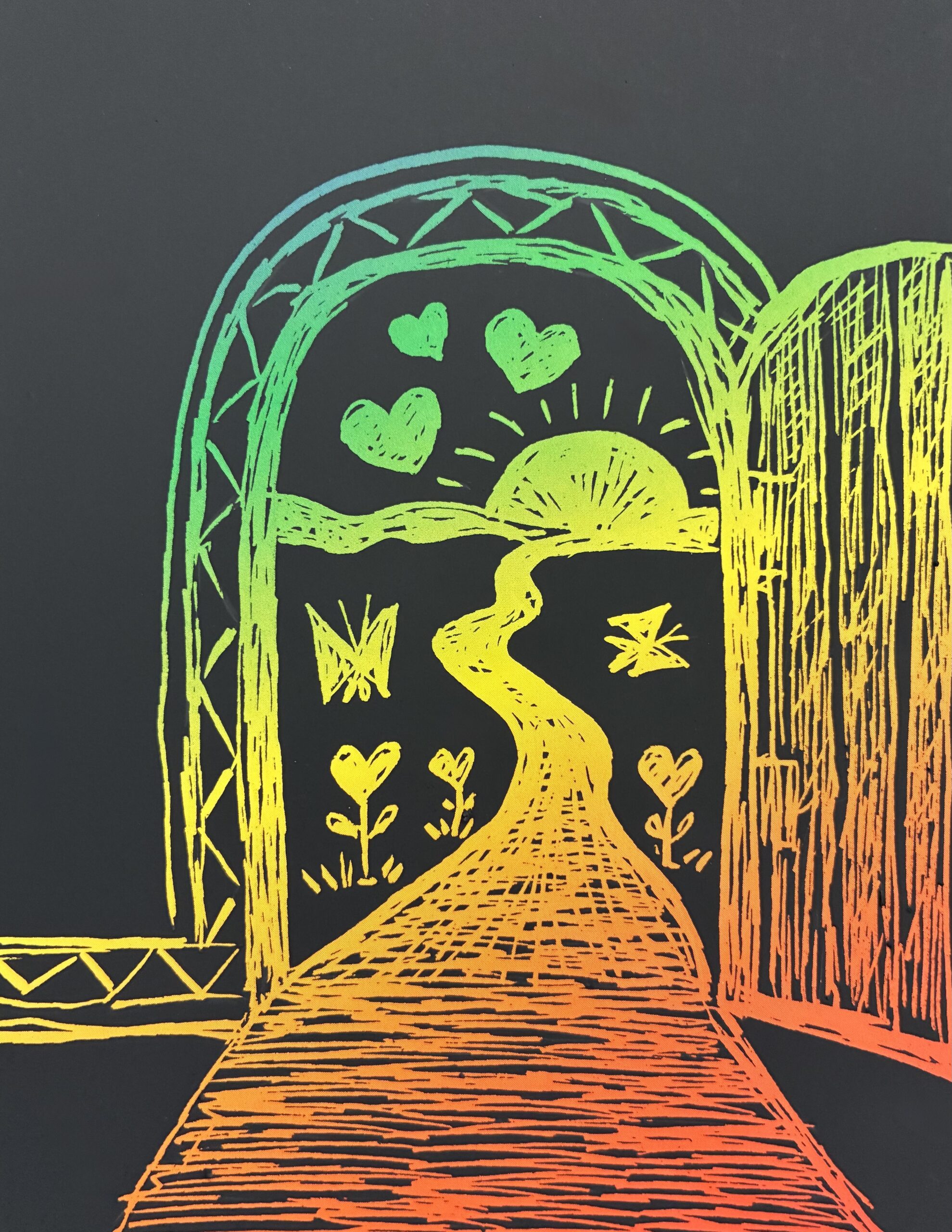
-Artwork © 2026 Jan Ketchel
The Greek roots of the word trauma identify a wounding or piercing of the physical body. In 1894, William James introduced the word traumata into psychology to identify mental injuries that act as “thorns to the spirit.”
Typically, the spirit, or psyche, constructs walls to protect its wounded part and in so doing disassociates from that part of itself, isolating it in an inner cave, no longer in contact with the rest of the free flowing energy of the self that lives and grows in everyday life.
Wilhelm Reich discovered that these traumatic caves were located in the physical body. He suggested the use of physical movements to free long split-off parts to join the free flow of energy of the greater self.
Francine Shapiro also incorporated physical movements into EMDR, such as eye movements, to allow fuller access to frozen parts of the self to be processed and join the free flow of energy of the greater self.
I introduce the practice of recapitulation, developed by the shamans of ancient Mexico. The practice of recapitulation frees energy that had been dispersed and stored throughout the body as a function of trauma, as well as the constraints socialization places upon the free flow of our inherent energy. When we recapitulate our life experiences and release the stored energy, we are restored to full energetic vitality.
All of these practices require us to return to the ‘”scene of the crime,” to that which lodged the thorn in the side of the spirit to begin with. To remove the thorn we must successfully reencounter the protagonist, without the need to remain hidden behind an erected wall of safety.
Ultimately, we aim to neutralize the threat to this exposure. This requires a total acceptance of all that happened and conscious inclusion of this experience in the history book of our life. The facts will never be erased, but now they are no longer triggers that limit our fuller experience of life.
Aside from the necessary processing and integration of all aspects of a trauma, is the condition of the now freed energy as it emerges from its isolated cave. This formerly isolated part-self is actually developmentally delayed. It has missed out on foundational experiences it needs to have to fully join with its greater self.
Many people make the mistake of feeling sorry for this part, which is understandable, for after all, it has missed out on so much of life. Often this results in a guilt and pressure to make up for all that it has missed. This can create a state of entitlement that misses its true needs: to developmentally catch up with the rest of the self, instead of being made-up to.
Neville Goddard introduced the practice of revisioning, which is a way to help the isolated part grow up and thrive in the present. Revisioning actually has us change the past by fully living the past that would have been ideal to have lived, and that would have delivered us to the present, without the limiting burden of the trauma that actually did happen.
Let me be clear. The past we have lived, trauma and all, can never be erased. However, alternative versions of the past can be fully lived that override all the limits created by that past. In this sense, the actual past becomes truly relativized, as fully living an alternative version in the imagination, experientially, fills in the necessary developmental experiences to manifest an enhanced present.
When we revision, we imagine the past we truly would have wanted to have happen, which then delivers us to the present, joyful and free to be all that we want to be.
We may begin by accessing a time when we actually did feel open and free, before the fall. We relive this spark of innocence, however brief, over and over, filled with the joyful sensations and emotions of unabashed freedom and receptivity.
With this freedom we can move into embodying, through our subtle senses of imagination, the scenes of our innerly created alternative drama. This includes the experience of sensations in the body that are generated by our joyous emotions, as well as hearing sounds and seeing scenes that spring spontaneously into our imagination. This is what Jung called active imagination, genuine interactions in an alternative reality.
In our imagination, we push beyond the earlier limits imposed in those critical periods of yesteryear. Bonding and rights of passage are fully operational in the imagination. Something we were always afraid to do—to speak out, to dance, to fall in love—is fully lived, with abandon.
This revisioning in our imagination happens many times as we incorporate all our sensations and emotions into our deepening experience of living the consequences of our changed past in our enriched present.
If we find ourselves blocked in letting go to our innocence and imagination, we either have not gone back far enough to the time of our true innocence, or we have not finished completely retrieving our cloistered part. Sometimes we must go back and forth many times. Recapitulation is the necessary precursor to passing into the room of revised imagination.
When we are fluid and really alive in experiencing our new past, for the realness that it is, we have actually seeded our subconscious to manifest the life we have dreamed of—in the flesh!
Our personal history book now includes an addition to the past that propels us into the full realization of our wholeness.
Just imagine,
Chuck